



How to Build a Warm-Up Content Library for New Social Media Accounts
Introduction
As social media platforms updates, the success of new accounts increasingly depends on behavioral authenticity rather than the tools being used. One of the most overlooked—but critical—components of this process is the warm-up content library.
Without a structured content foundation, even well-configured accounts can trigger detection systems due to unnatural posting patterns, repetitive messaging, or overly promotional intent.
This guide explains how to build a warm-up content library that supports account stability, reduces risk signals, and prepares accounts for long-term scaling.
What Is a Warm-Up Content Library?
A warm-up content library is a predefined collection of non-promotional, human-like posts used during the early stages of an account’s lifecycle.
Its purpose is to:
- Simulate natural user behavior
- Establish baseline trust signals
- Avoid early detection triggers
- Create content diversity from the start
Unlike marketing content, warm-up content is not designed to convert—it is designed to normalize the account.
Why It Matters
Modern platform detection systems evaluate:
- Content patterns
- Posting intent
- Behavioral consistency
- Engagement signals
Accounts that immediately publish:
- Promotional posts
- Repetitive structures
- AI-generated or templated content
are significantly more likely to be flagged or restricted.
A warm-up content library helps prevent this by introducing controlled randomness and human-like variation.
Core Content Categories
An effective library should include a balanced mix of content types. Each category plays a specific role in shaping account behavior.
1. Personal and Casual Thoughts
These posts form the foundation of your content strategy.
Characteristics:
- Informal tone
- No clear objective
- Slightly imperfect structure
Examples:
- “Not gonna lie, I’ve been overthinking everything lately”
- “Trying to get back into a routine… step one is showing up”
- “Some days are productive, some days are just not it”
Purpose:
Establish relatability and reduce perceived automation.
2. Light Engagement Content
These posts encourage minimal interaction without appearing engineered.
Characteristics:
- Simple questions
- Low effort to respond
- Broad appeal
Examples:
- “Coffee or tea?”
- “Morning person or night owl?”
- “What’s one app you use every day?”
Purpose:
Create natural engagement signals without triggering spam detection.
3. Lifestyle and Daily Activity
These posts simulate real-life behavior outside the platform.
Characteristics:
- Observational
- Routine-based
- Contextual
Examples:
- “Went for a walk today, needed that”
- “Trying to fix my sleep schedule”
- “Finally cleaned my workspace”
Purpose:
Reinforce the perception of a real, active individual.
4. Soft Value Content
These posts introduce subtle authority without promotional intent.
Characteristics:
- General insights
- No selling
- Broad applicability
Examples:
- “Consistency beats intensity over time”
- “Most people quit too early”
- “Simple systems work better than complex ones”
Purpose:
Position the account as thoughtful without appearing commercial.
5. Neutral or Curated Content
Optional but useful for behavioral diversity.
Characteristics:
- Shared content
- Reactions
- Generic commentary
Examples:
- “This is actually accurate”
- “Saw this earlier and it made sense”
Purpose:
Blend the account into normal platform activity.
Recommended Content Distribution
A balanced library should follow this approximate structure:
- Personal / Casual: 40%
- Engagement: 20%
- Lifestyle: 20%
- Soft Value: 10–15%
- Curated: 5–10%
This mix ensures the account does not appear overly focused on any single behavior type.
Posting Structure During Warm-Up
Content should not only be diverse—it must also be distributed naturally over time.
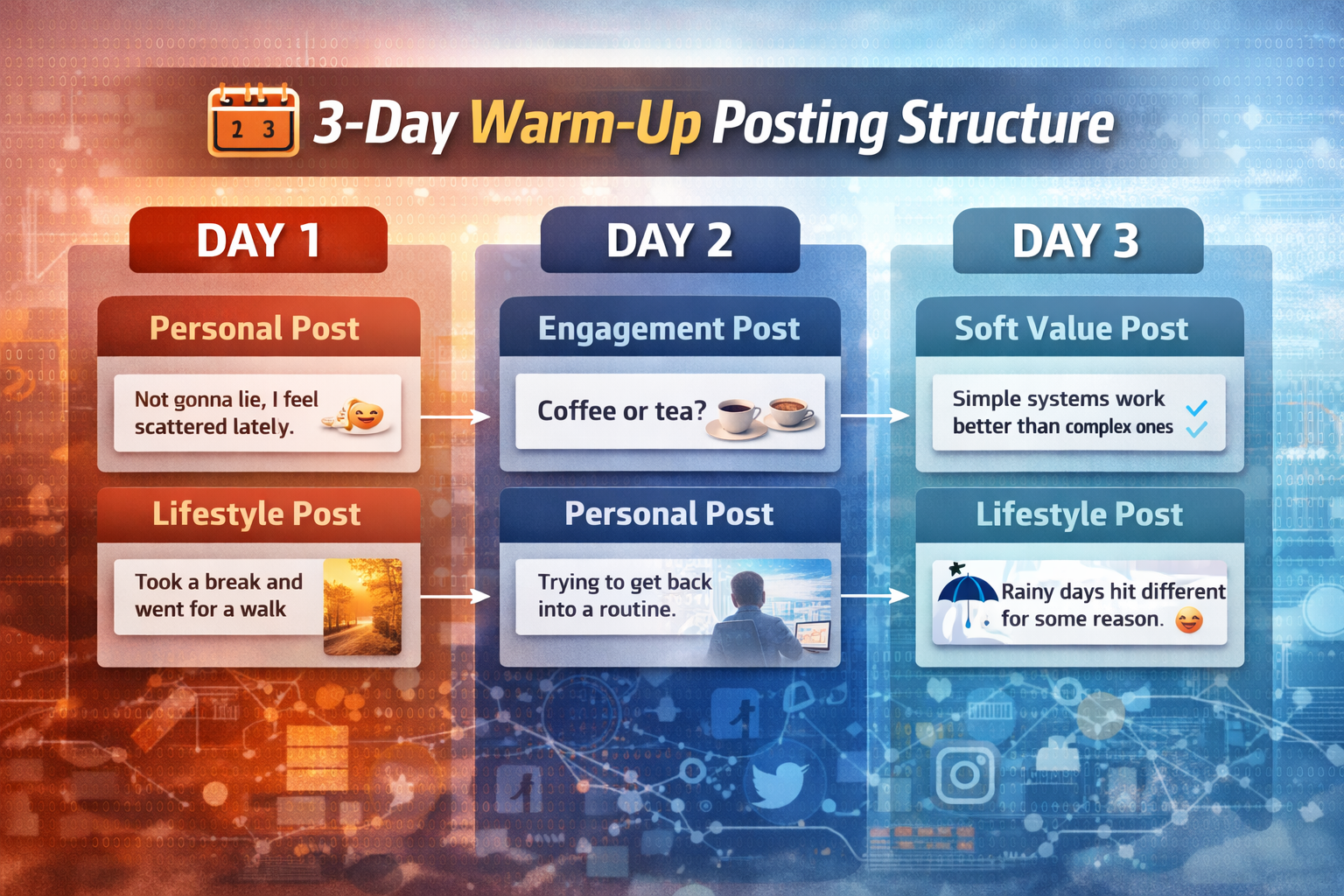
Example 3-Day Structure
Day 1:
- Personal post
- Lifestyle post
Day 2:
- Engagement post
- Personal post
Day 3:
- Soft value post
- Lifestyle post
Avoid rigid schedules. Minor inconsistency improves authenticity.
Content Guidelines and Restrictions
To maintain effectiveness, follow these rules strictly:
Avoid:
- Promotional messaging
- External links
- Repetitive phrasing
- Identical sentence structures
- Overuse of emojis
- Perfectly structured or overly polished language
Maintain:
- Variation in tone and length
- Occasional imperfections
- Natural phrasing
- Mixed formatting styles
The goal is not to appear optimized—the goal is to appear human.
Implementation in Automation Workflows
When using automation tools such as JarveePro, the warm-up content library should be integrated as a dedicated content source.
Best Practice Setup:
1. Initial Warm-Up Task
- Uses only warm-up content
- Low posting limits
- Combined with browsing simulation
2. Scheduled Posting Task
- Rotates content categories
- Maintains variation
3. Ongoing Maintenance Task
- Continues non-promotional posting
- Preserves behavioral balance
This layered approach ensures that the account continues to generate trust signals even after scaling begins.
Scaling the Content Library
For long-term use:
- Prepare 30–50 posts minimum
- Create variations of each post
- Rotate content across accounts carefully
- Adjust wording to avoid duplication patterns
Content reuse is acceptable—but only with sufficient variation.
A warm-up content library is not optional—it is foundational.
Accounts that skip this step tend to:
- Trigger detection systems early
- Receive action blocks
- Lose long-term viability
Accounts that implement it correctly gain:
- Increased stability
- Lower detection risk
- Sustainable scaling potential
Summary
To build an effective warm-up content library:
- Focus on non-promotional, human-like content
- Use multiple content categories for diversity
- Maintain natural variation and imperfection
- Structure posting behavior over time
- Integrate the library into automation workflows
The objective is simple:
Develop the account before attempting to use it.