



Do I Still Need LinkedIn Sales Navigator If I Have JarveePro?
Introduction
LinkedIn Sales Navigator has long been considered the standard tool for B2B prospecting, lead discovery, and relationship building on LinkedIn. It offers advanced filters, saved searches, and deep access to LinkedIn’s professional graph.
But a new question is becoming more common among marketers, agencies, and solo founders:
If I already use JarveePro, do I still need Sales Navigator?
At first glance, it seems like a simple tool comparison. But in reality, it’s a workflow question—not a feature question.
Because both tools are not just “doing search.” They are solving different parts of the same problem: how do you find the right people and turn attention into conversations?
Let’s break this down in a more practical, real-world way.
First, understand the real difference
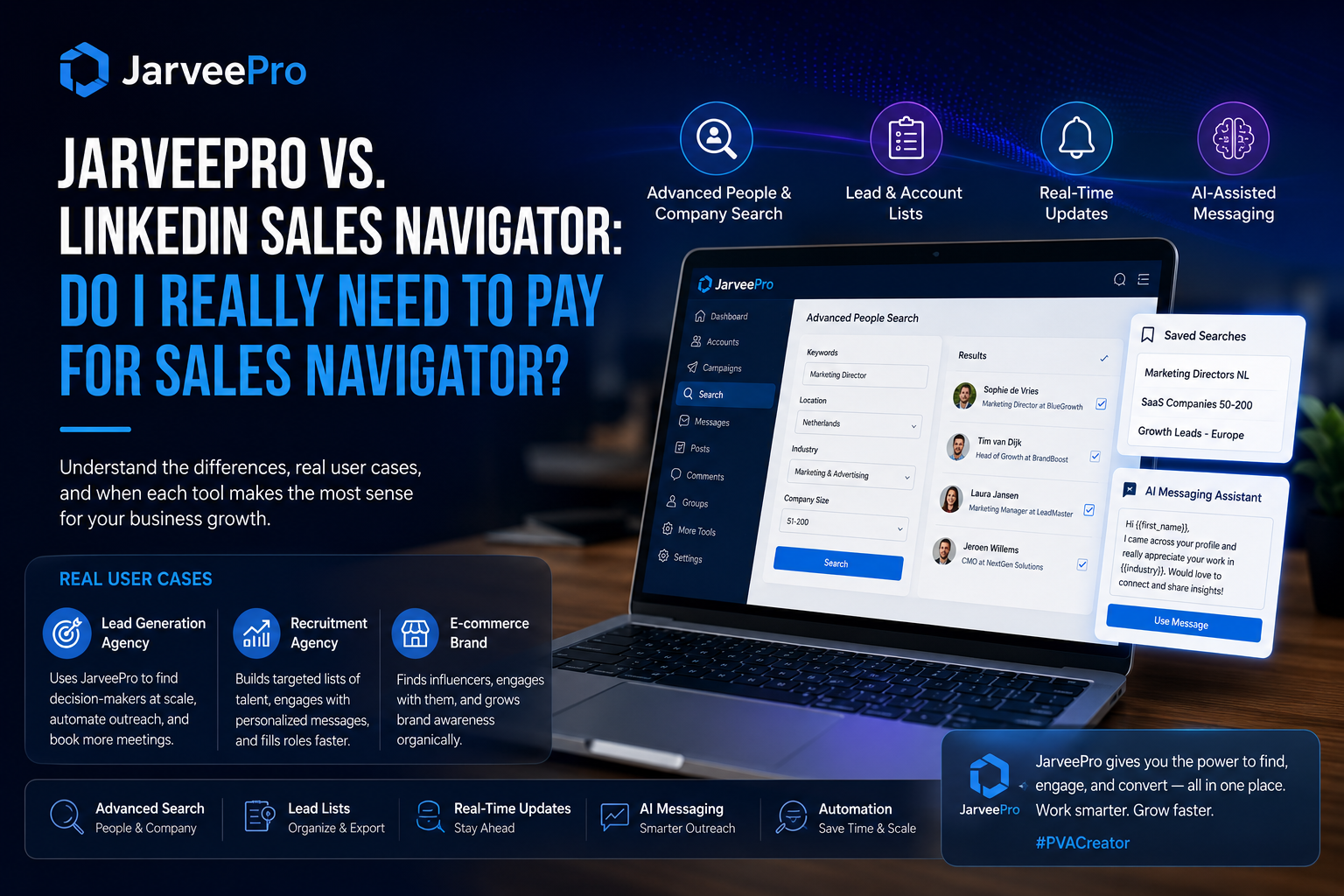
Before comparing features, it’s important to reframe what each tool actually represents.
LinkedIn Sales Navigator = Precision Discovery Tool
Sales Navigator is built to:
Help you find specific people inside LinkedIn’s ecosystem
Use advanced filters (job title, company size, seniority, industry)
Track accounts and lead changes
Stay inside LinkedIn’s native environment
Think of it as: “A search engine for LinkedIn professionals with premium filters.”
JarveePro = Multi-Channel Growth System
JarveePro is built for:
Finding and managing audiences across platforms
Automating engagement workflows
AI-assisted messaging and content generation
Scaling repetitive marketing actions
Think of it as: “A control center for running social media growth operations.”
The real question users are actually asking
Most people don’t really want to know: “Which tool has more features?”
They are actually asking: “Can I build a pipeline of leads and conversations without stacking multiple expensive tools?”
That’s where the decision becomes interesting.
Scenario 1: The Consultant Building Authority
Imagine a consultant trying to grow in a niche like cybersecurity or SaaS.
Using Sales Navigator alone:
Finds leads manually
Saves lists
Sends connection requests manually
Writes every message individually
Result:
High precision
Slow execution
Heavy manual workload
Using JarveePro workflow:
Identifies audience segments
Automates engagement with content and comments
Uses AI prompts for personalized responses
Scales visibility across multiple platforms
Result:
Faster visibility building
Less manual repetition
Broader reach beyond LinkedIn
Result:
Sales Navigator helps you find the right people.
JarveePro helps you stay visible to them consistently.
Scenario 2: The Agency Managing Multiple Clients
Now imagine a marketing agency managing 10–30 clients across industries.
Sales Navigator alone:
Works per LinkedIn account
Limited to LinkedIn ecosystem
Requires separate workflow per client
JarveePro approach:
Multi-client campaign management
Cross-platform scheduling
AI-assisted messaging systems
Centralized workflow control
Result:
Sales Navigator is like a “specialized tool per client.”
JarveePro is a “command center for all clients.”
For agencies, that difference is massive.
Scenario 3: The Founder Doing Cold Outreach
A SaaS founder wants leads fast.
Sales Navigator approach:
Build lead lists
Export manually
Send messages one by one
JarveePro approach:
Identify audience segments
Automate engagement cycles
Combine visibility + outreach + follow-up workflows
Important reality check:
Even perfect targeting does not guarantee replies. Visibility + repetition + timing matter just as much as filtering.
Where Sales Navigator is still stronger
Let’s be honest—Sales Navigator is not obsolete.
It still has advantages:
1. Native LinkedIn data
It pulls directly from LinkedIn’s ecosystem, which can sometimes be more accurate or up-to-date.
2. Deep filtering inside LinkedIn
If you need extremely specific filters (like niche enterprise roles), it’s very powerful.
3. Recruiter-grade precision
For hiring or enterprise B2B sales teams, it integrates into established workflows.
Where JarveePro changes the equation
JarveePro doesn’t try to beat Sales Navigator at being LinkedIn.
It changes the model entirely:
1. From “search → message”
to
“visibility → engagement → conversion loop”
Instead of: Find lead → message lead → hope for reply
It becomes: Appear in feed → engage consistently → build familiarity → message feels natural
2. Multi-platform advantage
LinkedIn is just one surface.
Real buyers exist across:
Instagram
Twitter/X
Facebook
YouTube
TikTok
JarveePro operates across these environments instead of isolating you inside one platform.
3. AI-driven scaling layer
Instead of manually repeating:
comments
messages
posts
You can structure prompts and workflows that maintain activity patterns at scale.
Ask yourself these 3 questions:
1. Do I only care about LinkedIn?
Yes → Sales Navigator becomes more relevant
2. Do I want multi-platform visibility + automation?
Yes → JarveePro becomes the core system
3. Do I need deep LinkedIn-only enterprise data?
Yes → Sales Navigator still wins in that niche
The real truth most people miss
This is not a “which tool replaces which” situation.
It’s a layering question:
Sales Navigator = precision targeting layer
JarveePro = execution + scaling layer
Some businesses use both.
But many users realize something important: You don’t always need more precision. You often need more presence.
And presence is what drives familiarity—and familiarity is what drives replies.
How to Make the Decision?
If your strategy depends on manually analyzing every lead before every action, Sales Navigator is essential.
But if your strategy depends on:
consistent visibility
scalable engagement
multi-channel growth
AI-assisted workflows
Then JarveePro is not just an alternative—it becomes the operating system.
The smartest approach is not choosing a tool.
It’s choosing a system.
Conclusion
So, do you still need LinkedIn Sales Navigator if you have JarveePro?
The honest answer is:
Yes, if your world is purely LinkedIn precision sales.
No, if your goal is scalable, multi-channel, automated growth systems.
And for most modern marketers, agencies, and founders, the second world is where things are moving.
Because in 2026, the winners aren’t the ones who search better.
They’re the ones who show up more consistently, everywhere their audience already is.