



Facebook Group Intelligence: Find Customers, Trends & Content Ideas
Most marketers think of Facebook Groups as places to promote something.
That is probably the least interesting thing about them.
A good Facebook Group is really a live conversation about a market.
People ask questions.
They complain about products.
They compare alternatives.
They look for recommendations.
They describe problems in their own words.
They ask, “What would you do?”
And occasionally, they reveal exactly what they are prepared to buy.
That makes Facebook Groups something much more valuable than another distribution channel.
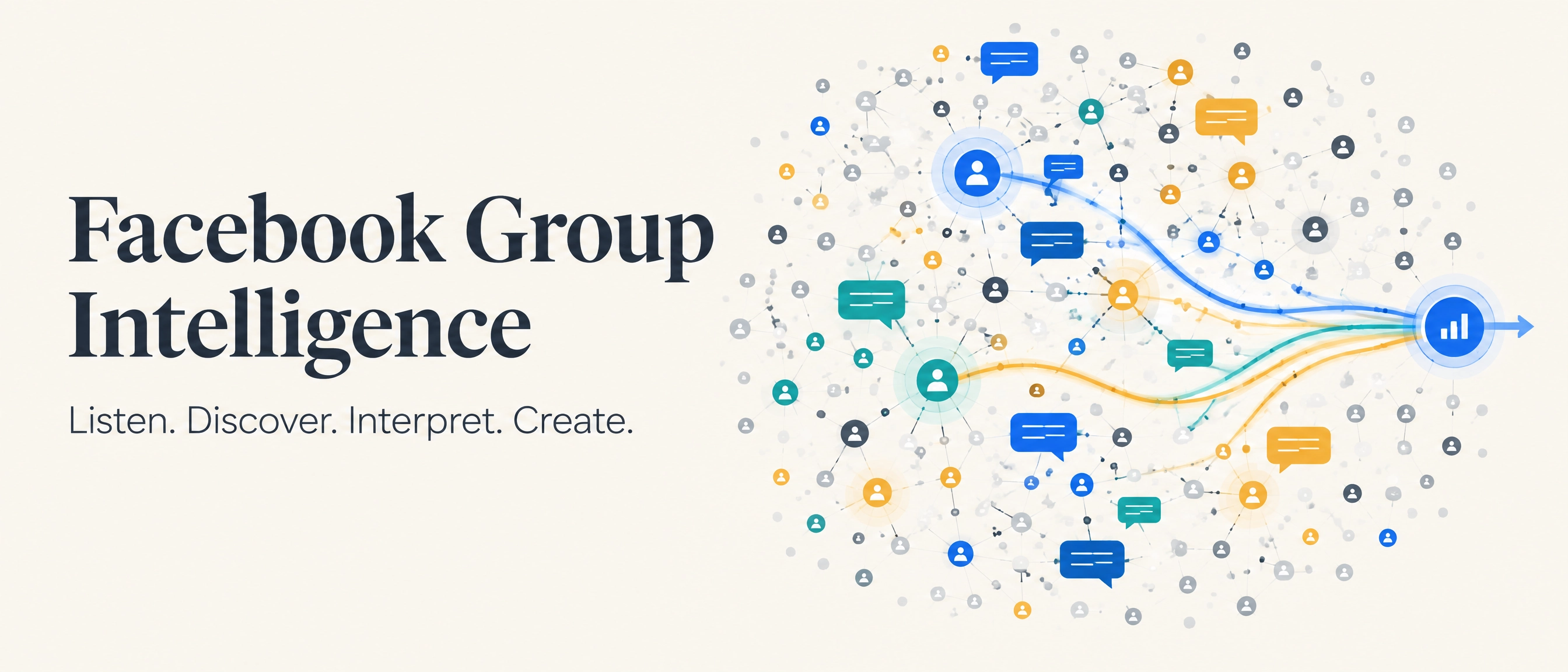
They are a source of market intelligence.
Facebook itself describes Groups as places where people connect around shared interests, learn, ask for advice and build communities. Meta has also highlighted the role of Groups in connecting people with local businesses and recommendations.
The challenge is scale.
One group is easy to watch.
Ten groups are manageable.
Fifty groups require a system.
Two hundred groups with dozens of keywords?
Now you have a research problem.
And that is where the idea of Facebook Group Intelligence becomes interesting.
Facebook Groups Are a Living Keyword Database
Traditional keyword research tells you what people search for.
Facebook conversations can tell you how people talk about what they need.
Imagine researching 200 groups with 50 carefully selected keywords.
You aren't merely looking for 10,000 combinations.
You're looking for patterns.
Perhaps one keyword appears repeatedly alongside:
“recommendation”
Another appears with:
“alternative”
Another with:
“problem”
Another with:
“anyone using…”
And another with:
“how do I…”
Those phrases have very different meanings.
The keyword tells you the topic.
The surrounding conversation tells you the intent.
The Most Valuable Keyword May Be a Question
Marketers often search for nouns.
Customers often speak in questions.
That distinction matters.
Compare:
“Facebook automation”
with:
“How do I manage 50 Facebook accounts?”
The first describes a category.
The second describes a problem.
And problems are often much closer to commercial intent.
This is why a Facebook keyword research strategy should include different types of search terms.
Product terms
What products or services are people discussing?
Problem terms
What problems are they trying to solve?
Comparison terms
What alternatives are they considering?
Question terms
What are they asking other people?
Recommendation terms
What are they asking others to recommend?
Competitor terms
Which products or brands are repeatedly mentioned?
Pain-point terms
What keeps going wrong?
This turns keyword research into intent research.
What Can 200 Facebook Groups Tell You?
Potentially, quite a lot.
Suppose you're monitoring 200 groups in one industry.
After filtering the conversations, you may discover:
Repeated questions
People keep asking the same thing.
That is a content opportunity.
Repeated complaints
People keep encountering the same problem.
That may reveal a product opportunity.
Repeated recommendations
Members repeatedly recommend the same solution.
That tells you something about the competitive landscape.
Emerging terminology
Customers begin using a new phrase.
That can become a new SEO keyword.
Competitor mentions
A competitor repeatedly appears in conversations.
That gives you something to investigate.
Unanswered questions
People ask questions but receive poor answers.
That may be your opportunity to create the definitive explanation.
This is where Facebook research becomes much more interesting than simply collecting URLs.
The Comment Section Can Be More Valuable Than the Original Post
Here is a subtle point.
The original post tells you what someone wanted to discuss.
The comments can tell you what the market thinks about it.
Imagine someone asks:
“Has anyone tried X?”
Twenty comments later, you may have:
- Three positive experiences
- Five negative experiences
- Two alternatives
- Several questions
- A pricing objection
- A recurring technical complaint
- A completely different use case
One post has turned into a miniature focus group.
That is why serious social listening should not stop at posts.
The conversation is the data.
Facebook Group Research Is Also Customer Research
Traditional market research can be expensive.
You might conduct surveys.
Interview customers.
Run focus groups.
Commission reports.
Analyze search data.
All of those methods can be useful.
But social communities provide another source:
people talking when they aren't being formally interviewed.
That can be revealing.
A person answering a question in a community may use language they would never put into a formal survey.
They might say:
“I tried three different tools and they all became expensive once I scaled.”
That's not merely a comment.
It is a market signal.
Search for Problems, Not Just Products
This is one of the biggest lessons for Facebook marketing.
If your company sells a solution, don't only monitor the name of your solution.
Monitor the problems surrounding it.
For a social media management company, that might include:
- manage multiple social media accounts
- social media scheduling problems
- managing 100 social accounts
- social media agency workflow
- Facebook account management
- content distribution
- social media automation
- multiple Facebook pages
- posting to multiple platforms
This gives you a much larger picture of the market.
You're no longer searching only for people who already know your product category.
You're finding people who are experiencing the problem your product exists to solve.
This Is Where Advanced Content Explorer Becomes Interesting
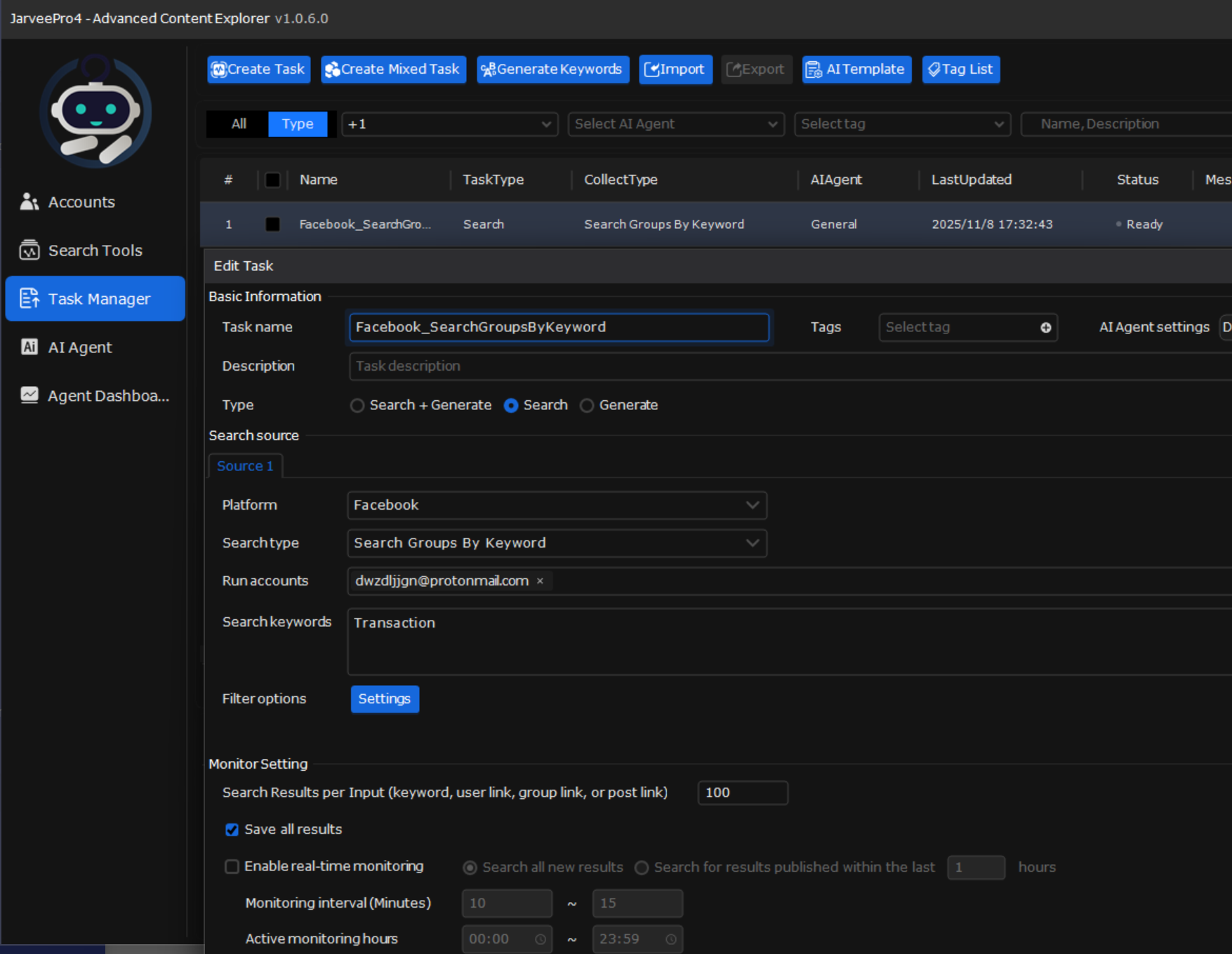
JarveePro's Advanced Content Explorer is designed around this broader idea of content discovery and data collection.
Its current documentation describes the tool as a way to discover profiles, pages, groups and posts, search by keywords and hashtags, monitor content, and turn discovered information into structured data for later workflows.
That makes it useful for a workflow such as:
Facebook Groups
↓
Keywords
↓
Relevant Posts
↓
Filter Results
↓
Identify Patterns
↓
Create Content
↓
Build Campaigns
The important word here is filter.
Finding 10,000 results isn't necessarily useful.
Finding the 100 conversations that actually matter can be extremely useful.
JarveePro's Content Explorer documentation describes filters for keywords, dates, likes, shares, comments, language and other conditions to narrow collected results.
Don't Collect Data. Build a Signal.
This distinction is crucial.
A database containing 50,000 Facebook posts may look impressive.
But if you don't know what the posts mean, you've simply created a larger pile of information.
The marketer's job is to turn:
Data → Information → Insight → Action
For example:
Data
1,000 posts mention “social media automation.”
Information
Most discussions concern managing multiple accounts.
Insight
Account management becomes a major pain point as businesses scale.
Action
Create content around:
“How to Manage 100 Social Media Accounts Without Losing Control”
Now the data has produced something useful.
Facebook Groups Can Tell You What to Write Next
This is perhaps one of the most practical uses.
Imagine you discover the same question appearing in 30 groups:
“What's the easiest way to manage multiple Facebook accounts?”
You now have evidence that this is not simply one person's question.
It is a recurring topic.
That can become:
- A blog article
- A YouTube video
- An FAQ
- A LinkedIn post
- A Facebook post
- A comparison guide
- A downloadable checklist
One conversation can become an entire content cluster.
This is content intelligence.
Instead of asking:
“What should we post today?”
you ask:
“What are people already asking?”
That's a much better starting point.
The Hidden SEO Advantage
There is another connection between Facebook research and search marketing.
People don't necessarily use the same language on Google that marketers put into keyword tools.
Social conversations can reveal unexpected long-tail phrases.
For example, you might begin with:
social media automation
and discover conversations around:
how to manage multiple social media accounts for a small business
or:
best way to manage 50 social media accounts
or:
how agencies manage multiple client social media accounts
These can become SEO opportunities.
The workflow becomes:
Facebook conversation
→
Customer language
→
Long-tail keyword
→
Content
→
Search traffic
→
Potential customer
That's a remarkably powerful loop.
The Best Facebook Marketing Strategy May Begin With Listening
There is an obsession with publishing.
Post more.
Post every day.
Post at 9 AM.
Post three times a day.
Create more Reels.
Create more images.
Create more videos.
But there is another question:
What are people actually talking about?
Facebook Groups are valuable precisely because they contain conversations that already exist.
Meta has described Groups as communities built around shared interests and discussions, while its own help documentation shows that public Groups can allow members and visitors to post and comment depending on the group's settings.
That means marketers can think about Facebook from two directions:
Broadcasting
and
Listening.
The second is often overlooked.
Don't Treat Every Group the Same
Two hundred groups do not necessarily equal two hundred opportunities.
A group can be:
- Highly active
- Barely active
- Extremely relevant
- Broadly relevant
- Commercial
- Educational
- Local
- Professional
- Consumer-focused
A group with 500 highly relevant members may be more useful for research than a group with 500,000 loosely related members.
So group research should evaluate quality, not just quantity.
Ask:
Is the audience relevant?
Are people actually posting?
Are questions being answered?
Are discussions substantive?
Are commercial conversations allowed?
Is the community appropriate for your brand?
This is where human judgment still matters.
What Should You Do With the Information?
This is where Facebook intelligence becomes a marketing system.
1. Create better content
Answer recurring questions.
2. Improve your product positioning
Use customer language rather than internal corporate language.
3. Find content gaps
Look for questions nobody answers well.
4. Understand competitors
Track how customers describe competing products.
5. Discover emerging topics
Watch which subjects suddenly appear repeatedly.
6. Improve SEO
Turn recurring customer language into long-tail content opportunities.
7. Improve social strategy
Understand which conversations deserve participation.
8. Build a feedback loop
Feed what you learn back into future content.
Now Facebook becomes more than a publishing platform.
It becomes part of your marketing research department.
The New Marketing Loop
Traditional marketing often looks like:
Create → Publish → Promote
A more intelligent model is:
Listen → Discover → Interpret → Create → Publish → Measure → Listen Again
That last step changes everything.
Because every campaign produces more information.
Every comment tells you something.
Every question tells you something.
Every repeated complaint tells you something.
Every unexpected phrase tells you something.
The marketing machine gets smarter because the audience keeps feeding it information.
Automation Should Follow Understanding
This is where the philosophy behind JarveePro becomes important.
Automation is excellent at repetitive execution.
It is not a substitute for knowing what you are trying to accomplish.
So the intelligent sequence is:
Human decides what matters
↓
Content Explorer finds relevant signals
↓
Human interprets the signals
↓
Content is created
↓
JarveePro helps organize and execute the workflow
This is very different from:
Scrape everything → automate everything → hope something works.
The first is a system.
The second is a button.
From Keywords to Conversations
This may be the bigger shift happening in digital marketing.
For years, marketers thought in keywords.
But customers don't live in keyword databases.
They live in conversations.
They say:
“I'm struggling with…”
“Has anyone tried…”
“What's the best…”
“Does anyone know…”
“I need an alternative…”
“Why does this keep happening?”
Those sentences contain something a keyword alone cannot provide:
context.
And context is increasingly valuable in an AI-driven marketing world.
AI can generate an article about almost anything.
The harder question is:
Which article should you create?
The answer may already be sitting inside thousands of conversations.
The Real Value of Facebook Group Intelligence
The biggest mistake would be to think the value is in collecting more Facebook data.
It isn't.
The value is in discovering something you didn't know before.
A new customer problem.
A new phrase.
A new competitor.
A new objection.
A new trend.
A new content opportunity.
A new market.
That is intelligence.
And intelligence changes decisions.
Conclusion
The smartest Facebook marketers may not be the people publishing the most.
They may be the people listening the best.
A Facebook Group is not merely a place to post.
It is a room full of people talking about a market.
If you listen carefully, you can hear:
what people want,
what they fear,
what they don't understand,
what they are buying,
what they are rejecting,
and what they will probably ask next.
That is why searching 200 Facebook groups with 50 keywords is more interesting than a scraping project.
Done properly, it becomes a form of continuous market research.
And once the questions are understood, the rest of marketing becomes easier:
Find the conversation.
Understand the problem.
Create something useful.
Join the conversation.
Learn from the response.
Repeat.
That's not just Facebook automation.
That's a marketing intelligence loop.