


How to Connect an AI Agent to TikTok Publishing Using an API
Build a smarter TikTok automation workflow with AI agents, custom integrations, video publishing, and JarveePro Nexus.
Imagine you've built an AI agent that understands your business.
It researches product questions, studies customer interests, drafts scripts, and sends approved ideas to an AI video generator.
Every morning, the system produces several videos ready for publication.
Then everything stops.
The videos sit in a folder because the AI agent doesn't know which TikTok account should publish them. It cannot confirm whether the accounts are available, coordinate publishing tasks, or determine whether yesterday's videos went live.
Someone still needs to open TikTok, choose the correct account, upload each video, prepare the caption, and check the result.
Your AI agent can create content, but it cannot complete the workflow.
This is a common problem in AI automation: intelligence and execution are two different capabilities.
The solution is not necessarily to build another AI model. It is to connect your existing AI workflow to a reliable publishing system.
1. Why AI Agents Need More Than Content Generation
AI agents are increasingly capable of performing multi-step work.
Depending on their tools and permissions, they can research information, organize data, generate scripts, create content briefs, and coordinate external applications.
But TikTok publishing introduces responsibilities that content-generation tools do not automatically handle.
An AI agent needs a way to identify the intended publishing account, submit an approved video, configure the posting task, and determine whether the operation succeeded.
It also needs to handle situations where a task cannot proceed.
For example, an account might require reauthorization, a video might fail validation, or a publishing service might reject a request.
Without an execution system, the AI agent can make plans but cannot reliably complete them.
Consider an AI-powered marketing workflow for a portable power station manufacturer.
The agent identifies common customer questions about battery capacity, charging time, and outdoor use. It prepares three video concepts and sends them for production.
After human review, the approved videos should be assigned to the appropriate TikTok accounts.
The agent's work is only useful if those approved assets can move into an actual publishing workflow.
That's where APIs become important.
2. What Is a TikTok Publishing API?
An API, or Application Programming Interface, allows software systems to communicate through defined requests and responses.
In a TikTok publishing workflow, an API may allow an authorized application to submit content or interact with supported account and publishing operations.
Instead of requiring a person to perform every action manually, another application can initiate supported tasks programmatically.
There are two important integration approaches to understand.
TikTok's official Content Posting API
TikTok provides official developer interfaces for authorized content-posting applications.
Depending on the available permissions and application configuration, supported workflows may include uploading content or publishing directly.
However, developers must follow TikTok's authorization, scope, audit, and content-posting requirements.
Not every developer application automatically receives unrestricted direct-publishing capabilities.
Businesses considering this approach should begin with the current documentation at TikTok for Developers.
A publishing platform with its own Integration API
A second approach is to connect an AI system to software that already manages social media accounts and publishing tasks.
For example, JarveePro Nexus provides centralized account management, TikTok publishing campaigns, and an Integration API for supported programmatic operations.
Rather than building every account-management component from scratch, developers can integrate their own workflow with the capabilities exposed by Nexus.
The important difference is architectural.
TikTok's official API connects an authorized developer application to TikTok's supported platform interfaces.
The JarveePro Nexus Integration API connects external software to supported operations inside the Nexus environment.
They are not interchangeable, and their available capabilities and permissions may differ.
3. The Missing Layer Between AI Video Generation and TikTok
Suppose your AI system already has three components.
The first researches topics and develops content ideas.
The second generates videos.
The third evaluates whether the videos meet your requirements.
What happens after approval?
Many developers assume they need to create a custom TikTok uploader immediately.
But publishing involves more than transferring a video file.
The system must know which account to use, what content belongs to that account, how the publishing task is configured, and how to handle failures.
A dedicated publishing layer helps separate these responsibilities.
A practical architecture can be organized around four components.
AI planning: Researches topics, prepares scripts, and proposes content.
Content production: Generates or edits videos and prepares captions and other assets.
Publishing execution: Manages supported account and publishing operations.
Reporting and feedback: Collects available task results and performance information for future decisions.
JarveePro Nexus can serve as the publishing execution component in this architecture.
The AI system doesn't need to become a social media account manager itself. It needs a supported way to communicate with one.
4. How JarveePro Nexus Fits Into an AI Agent Workflow
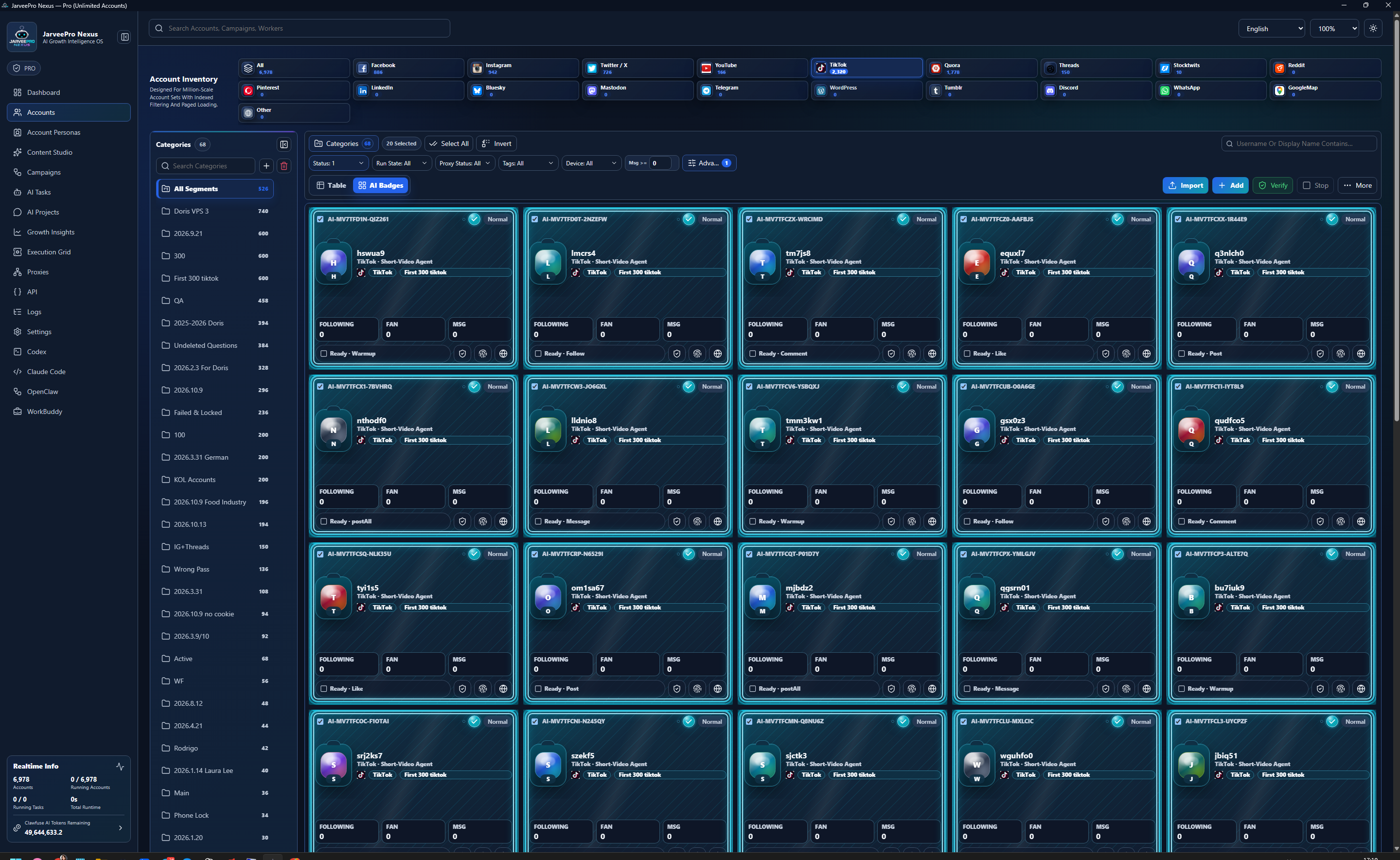
JarveePro Nexus is designed to support multi-account social media operations, including TikTok posting campaigns.
Its Campaigns dashboard allows users to configure publishing tasks, select participating accounts, and prepare content inputs.
For TikTok posting, the demonstrated interface includes:
Video File
Title Text
Label Text
User Text for user mentions or tagging
Account selection and distribution settings
An option to use results from an AI Project
These capabilities matter because an external AI agent may produce several assets, but the publishing system still needs to associate each asset with an appropriate account and campaign.
For example, a company may operate separate TikTok accounts for outdoor equipment, portable power solutions, and technical product education.
An AI agent could generate different video briefs for each audience.
After approval, the corresponding videos could be organized into the appropriate Nexus publishing workflows.
This creates a clearer division of responsibilities: the AI agent prepares content and makes recommendations, while Nexus manages supported publishing execution.
Importantly, an external AI agent does not automatically gain complete control of Nexus simply because the Integration API exists.
The developer must implement the connection using the operations actually supported by the installed API version.
5. Understanding the JarveePro Nexus Integration API
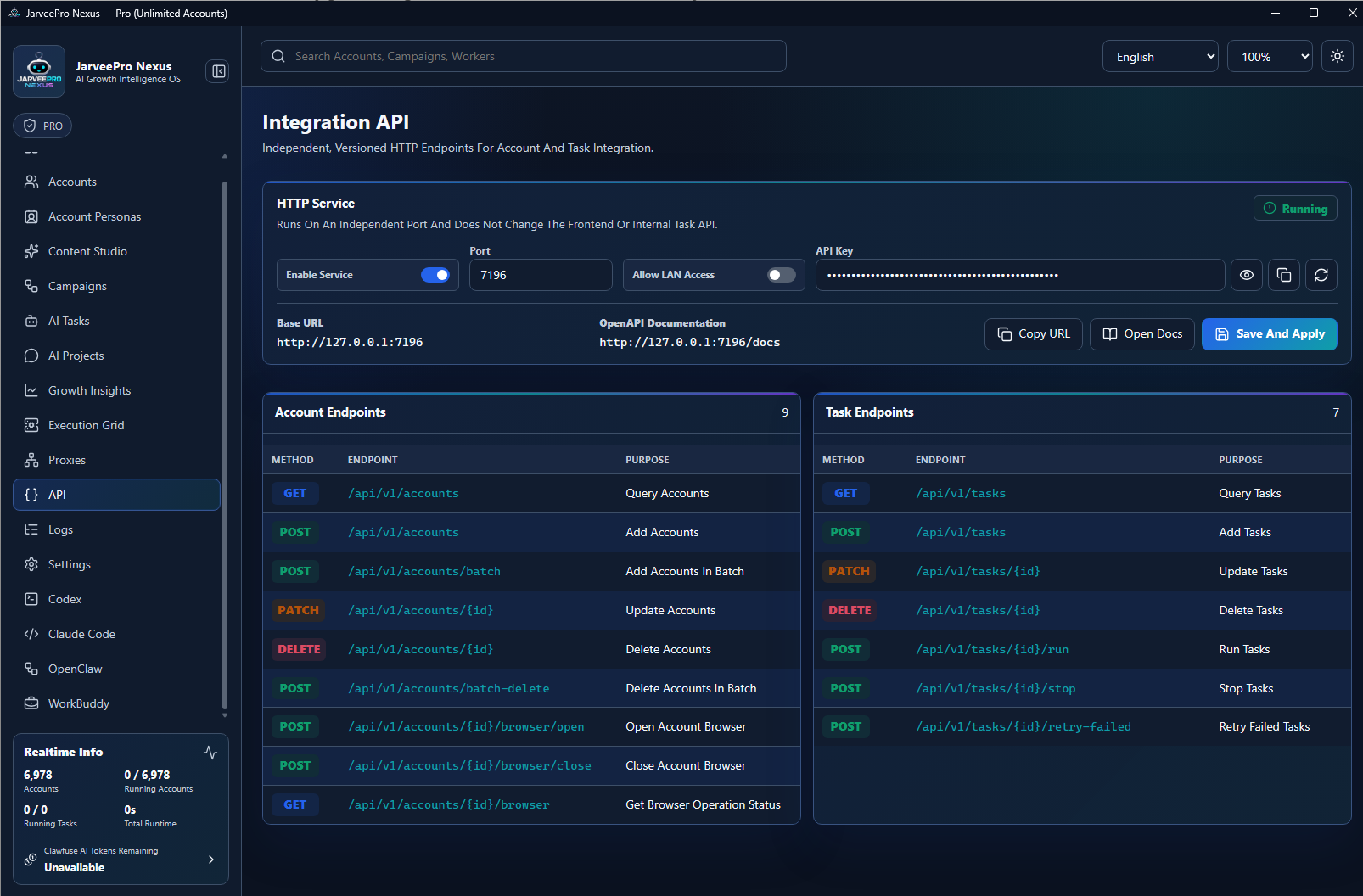
JarveePro Nexus includes an Integration API interface with an HTTP service.
In the demonstrated Nexus Pro environment, the API settings show a configurable service, authentication key, and local OpenAPI documentation.
For example, the displayed local documentation address is:
http://127.0.0.1:7196/docs
This is a local service address from the demonstrated configuration, not a public cloud endpoint that every customer can access.
The port and access configuration may differ between installations.
The OpenAPI documentation allows developers to inspect supported operations, their request parameters, and their expected responses.
The demonstrated API documentation includes account-related operations such as updating account information and opening or closing managed browser sessions.
Developers should consult their current installation's API documentation to confirm the available publishing, task, and reporting operations before designing an integration.
Why OpenAPI documentation matters
AI coding tools are particularly useful when they have a reliable description of the software they need to work with.
Instead of guessing endpoint names or inventing request parameters, a developer can use the API specification to understand which operations exist.
This reduces the risk of building an integration around unsupported functionality.
It also makes testing and maintenance easier when software versions change.
API credentials should remain private, and external access should be restricted to authorized systems.
6. Can You Connect ChatGPT, Codex, or Claude to TikTok Publishing?
Yes, these tools can participate in a custom TikTok publishing workflow, but they play different roles.
ChatGPT: Content planning and workflow assistance
ChatGPT can help develop content strategies, prepare scripts, classify content ideas, and generate structured information for a publishing workflow.
Connecting those outputs to an actual publishing system requires an application or integration with the necessary permissions.
A conversation with ChatGPT alone does not automatically create access to TikTok accounts.
OpenAI Codex: Developing the integration
Codex is useful for software-development work.
A developer can use it to inspect API documentation, design an integration, implement supported requests, create tests, and troubleshoot errors.
For example, a development project might need to connect an AI video-generation service to a Nexus publishing workflow.
Codex can assist with creating that connector.
However, Codex does not make unsupported API operations available. The integration must respect the capabilities of the actual services involved.
Claude and other AI coding tools
Claude and other coding assistants can also help developers design workflows and work with API specifications.
The choice of coding assistant is less important than having clear documentation, valid credentials, and a well-defined publishing process.
MCP: Connecting AI applications to tools
The Model Context Protocol, or MCP, provides a standardized way for compatible AI applications to access external tools and resources.
A developer could build an MCP server that exposes selected, authorized publishing operations through an underlying API.
For example, the server might offer a tool that requests the status of a supported publishing task.
But MCP is not itself a TikTok publishing service.
It is an integration protocol.
An MCP server connected to Nexus would still depend on the capabilities and permissions exposed by the Nexus Integration API.
7. A Practical Example: Building an AI TikTok Video Publishing Workflow
Consider a business that creates educational TikTok videos about lawn maintenance equipment.
It wants to publish useful product demonstrations, maintenance tutorials, and buying guides across several authorized accounts.
Instead of generating hundreds of videos immediately, the team begins with a controlled workflow.
Step 1: Research real customer questions
The AI agent gathers approved product information, customer FAQs, and relevant market research.
It identifies questions such as:
"How do I choose the right lawn mower for a small garden?"
"What is the difference between brushless and brushed motors?"
"How often should mower blades be sharpened?"
The team verifies that the questions and product information are relevant.
Step 2: Develop audience-specific scripts
The AI agent creates scripts for different audiences.
A homeowner may need simple maintenance advice.
A professional landscaping company may care more about operating costs, durability, and service requirements.
The scripts should reflect those differences.
Step 3: Generate video assets
An external AI video service prepares drafts using approved footage, product images, narration, and visual elements.
The business reviews the results for factual accuracy and content quality.
Step 4: Approve content for publication
A human reviewer checks product claims, captions, demonstrations, and any required disclosures.
Approved content is then marked as ready for publishing.
Step 5: Prepare the publishing task
The integration associates approved content with the intended TikTok account and publishing configuration.
JarveePro Nexus provides the account-management and campaign-publishing environment.
Any programmatic task submission must use operations verified in the installed Nexus API documentation.
Step 6: Check the result
The system retrieves available task status information and records whether the publishing operation completed or requires attention.
Failures should be handled explicitly rather than assuming every submitted task was successful.
Step 7: Improve the next content cycle
The team compares available engagement and performance information with its original objectives.
It then uses those findings to improve future scripts, demonstrations, and content priorities.
This is a more meaningful application of AI than simply producing videos at the highest possible volume.
8. Why Human Approval Still Matters in AI Publishing
One of the most tempting ideas in AI automation is to eliminate human involvement entirely.
But removing review can introduce expensive mistakes.
Imagine an AI agent generating a product comparison based on outdated specifications.
The video is published across several accounts before anyone notices the error.
Or an AI-generated demonstration depicts a safety feature that the product doesn't actually include.
The automation may work perfectly from a technical perspective while creating serious commercial and reputational problems.
A better system uses human approval where it matters most.
Product claims, legal or commercial disclosures, sensitive content, and major campaign decisions should be reviewed before publication.
The AI agent can still automate repetitive preparation work.
The publishing system can still reduce administrative effort.
Human involvement becomes a quality-control mechanism rather than a requirement to manually perform every task.
9. What Developers Often Overlook: An AI Agent Needs a Recovery Strategy
Most AI automation demonstrations focus on successful execution.
The agent receives an instruction, calls a tool, and completes a task.
Real business operations are rarely that simple.
What happens if the account session expires?
What if the video file is missing?
What if the publishing task fails after submission?
What if the same request is accidentally sent twice?
These problems are not unique to TikTok. They are normal software-integration challenges.
A production workflow should therefore include task identifiers, validation, status tracking, error handling, and appropriate retry controls.
For example, if a publishing request times out, the integration should first determine whether the task was already created before submitting it again.
Otherwise, an attempt to recover from a failure could create duplicate content.
The system should also record which content was approved, which account was selected, and which operation was performed.
This makes troubleshooting and auditing easier.
The difference between an impressive AI demo and a dependable AI operation is often what happens when something goes wrong.
10. Build the Integration Around Business Goals, Not Just API Calls
An API integration can successfully publish 100 videos and still fail to create business value.
That happens when developers focus entirely on execution without considering why the content is being published.
For example, a manufacturer may want to reach professional distributors in several countries.
The important questions are not simply how many accounts can be connected or how many videos can be scheduled.
The business needs to understand which markets it serves, what information buyers require, and which content attracts relevant inquiries.
An AI workflow should therefore connect publishing operations to a larger marketing strategy.
For one business, success may mean generating qualified distributor inquiries.
For another, it may mean educating existing customers and reducing repetitive support questions.
For an affiliate marketer, it may mean improving conversion quality and commission profitability.
The technology should serve the objective.
Not the other way around.
Conclusion: Give Your AI Agent a Way to Execute
AI agents are becoming increasingly capable of researching topics, generating content, and coordinating complex workflows.
But a useful TikTok automation system needs more than an intelligent content generator.
It needs a way to manage accounts, prepare publishing tasks, execute supported operations, verify results, and recover from errors.
JarveePro Nexus provides a centralized TikTok account-management and publishing environment, together with an Integration API that developers can use for supported custom workflows.
Tools such as Codex, Claude, and MCP-based integrations can help connect the surrounding systems, provided the implementation respects the documented capabilities of each service.
The result is a more practical division of work.
AI helps decide what to create. Human reviewers determine what is ready. The publishing system executes the approved work. Performance data informs what happens next.
That's how an AI agent becomes part of a real content operation rather than another tool that stops after generating a video.
Explore JarveePro Nexus
Visit JarveePro to learn more about TikTok account management, scheduled publishing, AI Projects, and the Nexus Integration API.