



From One Voice to Millions: The New Age of Storytelling
For most of human history, if you wanted to change people's minds, you needed to stand in front of them.
A king spoke to his people.
A general spoke to his soldiers.
A priest spoke to a congregation.
A politician stood before a crowd and delivered a speech.
A teacher gathered students around a table.
A storyteller sat beside a fire.
The technology was simple.
One voice.
Many listeners.
And yet, some of the most powerful moments in human history began exactly this way.
Not with a machine.
Not with an algorithm.
With someone standing up and saying:
“Listen.”
The Power of One Voice
We often remember history through its great speeches.
Not because every sentence was perfect, but because the speaker managed to turn an idea into something other people could carry.
A speech could make strangers feel that they belonged to the same story.
A leader could give people a name for something they had been feeling but could not express.
A storyteller could take something that happened to one person and make thousands of people feel that it happened to them.
That is the strange power of storytelling.
It takes something personal and makes it collective.
One person's experience becomes another person's memory.
One person's idea becomes another person's belief.
One person's story becomes part of the story of an entire generation.
For centuries, the storyteller's greatest limitation was also beautifully simple:
How many people can hear you?
Then Humanity Learned How to Multiply a Voice
The printing press changed the question.
A person no longer needed to speak to everyone directly.
Their words could travel without them.
A book could cross a border.
A newspaper could reach a city.
A letter could cross an ocean.
The human voice had discovered something extraordinary:
distance did not have to stop a story.
Then came radio.
One voice could enter thousands of homes at once.
Then television.
The storyteller could now be seen as well as heard.
A single person could speak from one room while millions of people watched from somewhere else.
The scale became almost unimaginable.
But the structure remained familiar.
One voice.
Millions of listeners.
And Then the Internet Broke the Pattern
The internet did something different.
It did not simply make the microphone louder.
It handed microphones to everyone.
Suddenly, the audience could become the speaker.
The reader could become the publisher.
The customer could become the reviewer.
The viewer could become the creator.
The person watching from the back of the room could suddenly walk onto the stage.
And then social media accelerated everything.
Today, a person can wake up in Los Angeles, publish something from a phone, and have someone on the other side of the planet reading it seconds later.
A teenager can build an audience larger than a television station.
A small company can communicate directly with customers without owning a newspaper.
An artist can find an audience without waiting for a gallery.
A researcher can publish an idea without waiting for a publisher.
A creator can build a media operation from a laptop.
The old relationship between speaker and audience has been broken apart.
We are all potentially both.
But Something Strange Happened
When everyone received a microphone, we discovered that the microphone was not the difficult part.
The difficult part was knowing what to say.
And then came another problem.
Once you know what to say, how do you say it to different people?
The person interested in technology may care about one part of your story.
The entrepreneur may care about another.
The artist may see something completely different.
The beginner needs an explanation.
The expert wants depth.
The longtime follower wants the next chapter.
The new visitor needs the first chapter.
The story is the same.
But the doorway is different.
This is where modern storytelling becomes much more interesting.
We Are No Longer Living in the Age of One Audience
There was a time when a storyteller could imagine an audience as one large crowd.
Today, there may be hundreds of smaller crowds.
A brand might speak to customers on Instagram.
To creators on TikTok.
To professionals on LinkedIn.
To communities on Reddit.
To viewers on YouTube.
To conversations on X.
And within each platform, there may be dozens or hundreds of different communities.
The storyteller now faces a completely new challenge.
It is no longer enough to have a voice.
You need a system for carrying the voice.
Imagine a Story With a Thousand Doors
Imagine entering an enormous museum.
There is one exhibition inside.
But it has a thousand doors.
One door opens into history.
Another opens into art.
Another opens into science.
Another opens into personal stories.
Another opens into technology.
Another opens into the future.
You don't need to enter through all of them.
You simply need to find the door that makes you curious.
Once you enter, the rooms begin connecting.
You realize that the story you thought was about one thing is actually about something much larger.
That is how a modern social presence can work.
Not one account shouting the same message everywhere.
But a network of voices, perspectives, conversations, and stories—each contributing something to a larger narrative.
This Is Where Technology Becomes Interesting
For a long time, automation was mostly about saving time.
Schedule something.
Repeat something.
Publish something.
Move on.
Useful, certainly.
But there is a much bigger possibility.
What if technology could allow one storyteller to manage an entire network of conversations?
What if one idea could become many different pieces of content?
What if those pieces could reach different audiences?
What if different accounts could play different roles?
What if the storyteller could spend less time moving content from one place to another and more time thinking about the story itself?
Now automation stops being merely a convenience.
It becomes infrastructure for communication.
The Machine Should Not Become the Storyteller
This distinction matters.
The machine can move information.
It can organize.
It can distribute.
It can repeat.
It can monitor.
It can help execute.
But meaning is different.
A machine can place two paintings next to each other.
It cannot automatically know why you want the visitor to see them together.
That decision belongs to the storyteller.
The human decides:
This belongs here.
This should come first.
This person needs to hear this version.
This idea needs more context.
This story should be repeated.
This one should be left unsaid.
That is judgment.
And judgment is where storytelling begins.
The New Storyteller Has a Different Kind of Power
This is perhaps the biggest change of all.
The great storytellers of the past needed institutions behind them.
A newspaper.
A television network.
A political organization.
A publishing house.
A studio.
Today, an individual can build a remarkably sophisticated communication network with tools that previous generations could barely imagine.
The storyteller can become the publisher.
The publisher can become the network.
And the network can become the distribution system.
That changes the economics of attention.
It changes who gets heard.
It changes how ideas spread.
And it changes what one determined person can build.
From One Voice to Millions
This is the journey we have been on for thousands of years.
We began with the human voice.
Then we invented ways to preserve it.
Then ways to reproduce it.
Then ways to broadcast it.
Then ways to connect every voice to every other voice.
And now we are building systems that help us manage the enormous complexity created by that connection.
The progression is remarkable:
Voice → Writing → Printing → Broadcasting → Internet → Social Networks → Automation → AI
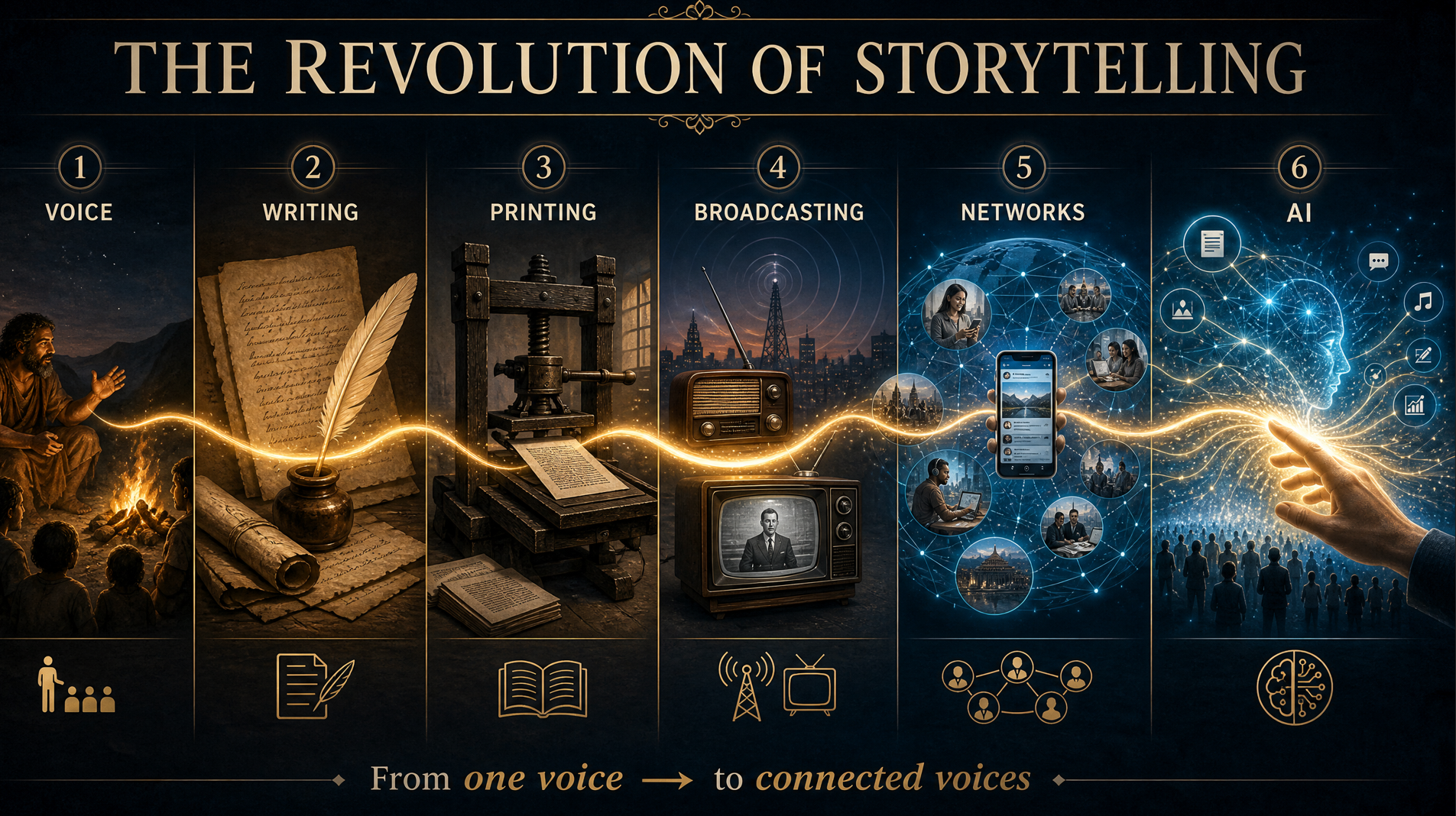
Each step removes another limitation.
The storyteller can travel farther.
Speak faster.
Reach more people.
Adapt the message.
Listen to the response.
And continue the story.
But More Voices Do Not Automatically Create a Better Story
This may be the most important lesson.
Millions of voices do not automatically create wisdom.
More content does not automatically create understanding.
More accounts do not automatically create influence.
More technology does not automatically create meaning.
The world does not need more noise.
It needs better stories.
Stories that connect things.
Stories that give context.
Stories that help people understand why something matters.
Stories that make people feel that they have discovered something rather than simply been advertised to.
And this is where the storyteller's role becomes more important—not less.
Because when everyone can publish, curation becomes a form of leadership.
The Story We Are Building Now
This is the part of the story that is still being written.
We are entering a world where a person does not necessarily have to choose between being a creator and building a network.
Technology can handle more of the repetitive work.
AI can help with more of the cognitive work.
Automation can coordinate more of the operational work.
And that leaves something increasingly valuable for the human being:
the decision about what deserves to be said.
That may be the most important role left.
Not typing every post.
Not clicking every button.
Not manually opening every account.
But deciding what the world should hear next.
The Storyteller Has Finally Been Given a Bigger Stage
Perhaps this is what has changed most.
The great storyteller of the past stood before a crowd.
The modern storyteller can stand before a network.
Not necessarily one enormous audience.
Something more interesting.
Thousands of small audiences.
Different people.
Different interests.
Different languages.
Different perspectives.
Different doors into the same story.
And somewhere inside that network, a simple idea can begin moving.
One person sees it.
Then another.
Then another.
Someone responds.
Someone shares it.
Someone adds something of their own.
The story changes.
It grows.
It travels.
Eventually, the storyteller may no longer be able to see every place the original idea has gone.
And perhaps that is the ultimate achievement of storytelling.
Not making everyone listen.
But creating something that continues speaking after you have stopped.
That is the new age of storytelling.
And we are only at the beginning.