



How to Find B2B Buyers on X (Twitter) With AI Marketing
Your Next B2B Customer May Already Be Talking About Their Problem on X
How businesses can turn industry conversations into market intelligence, useful content, and new sales opportunities.
A company manufactures industrial safety equipment. Its products are certified for their intended applications, its engineers understand the industry, and its sales team has spent years building relationships with distributors.
The company has a website, a product catalog, and an X account.
Every week, its marketing team publishes product photographs, company announcements, and occasional promotional offers.
Yet the posts attract little attention, and the sales team rarely receives an inquiry through social media.
Meanwhile, somewhere on X, a safety manager is discussing difficulties selecting protective equipment for a particular industrial application. A distributor is asking how to evaluate unfamiliar suppliers. An engineer is comparing the operating limitations of different materials.
These conversations may never mention the manufacturer's brand.
But they reveal the kinds of problems its products are designed to address.
The manufacturer's challenge isn't simply that its posts receive too few impressions. It needs to become visible to the right people while those people are investigating problems, comparing options, and forming purchasing preferences.
That requires a different approach to X marketing.
The Buying Process Often Begins Before Anyone Contacts a Supplier
Traditional B2B marketing frequently begins with the product.
A manufacturer prepares a catalog, explains its specifications, publishes technical photographs, and waits for interested buyers to request a quotation.
Those materials are important, but they generally serve people who already know what they're looking for.
Many potential buyers are still trying to understand their problem.
An industrial safety manager might be evaluating whether existing protective equipment is suitable for a new production process.
A distributor might be considering whether a new product category offers sufficient demand and after-sales support.
A procurement specialist might be comparing suppliers but remain uncertain about documentation, product consistency, or delivery reliability.
None of these people necessarily begins by searching for a particular manufacturer.
They begin with questions.
And some of those questions appear in public industry conversations.
This is why X can be valuable beyond its role as a publishing platform. It can provide a window into the language, concerns, and priorities of people discussing an industry.
The opportunity is to understand those conversations before deciding what to publish.
What Buyers Ask—and What They Are Trying to Accomplish
Consider a distributor asking whether a manufacturer can supply replacement components.
A conventional marketing response might list available spare parts.
But the distributor's concern may be broader: can this supplier help me protect my reputation after I've sold the product?
If customers experience equipment failures and replacement parts are unavailable, the distributor bears much of the commercial damage.
The same principle applies across industrial markets.
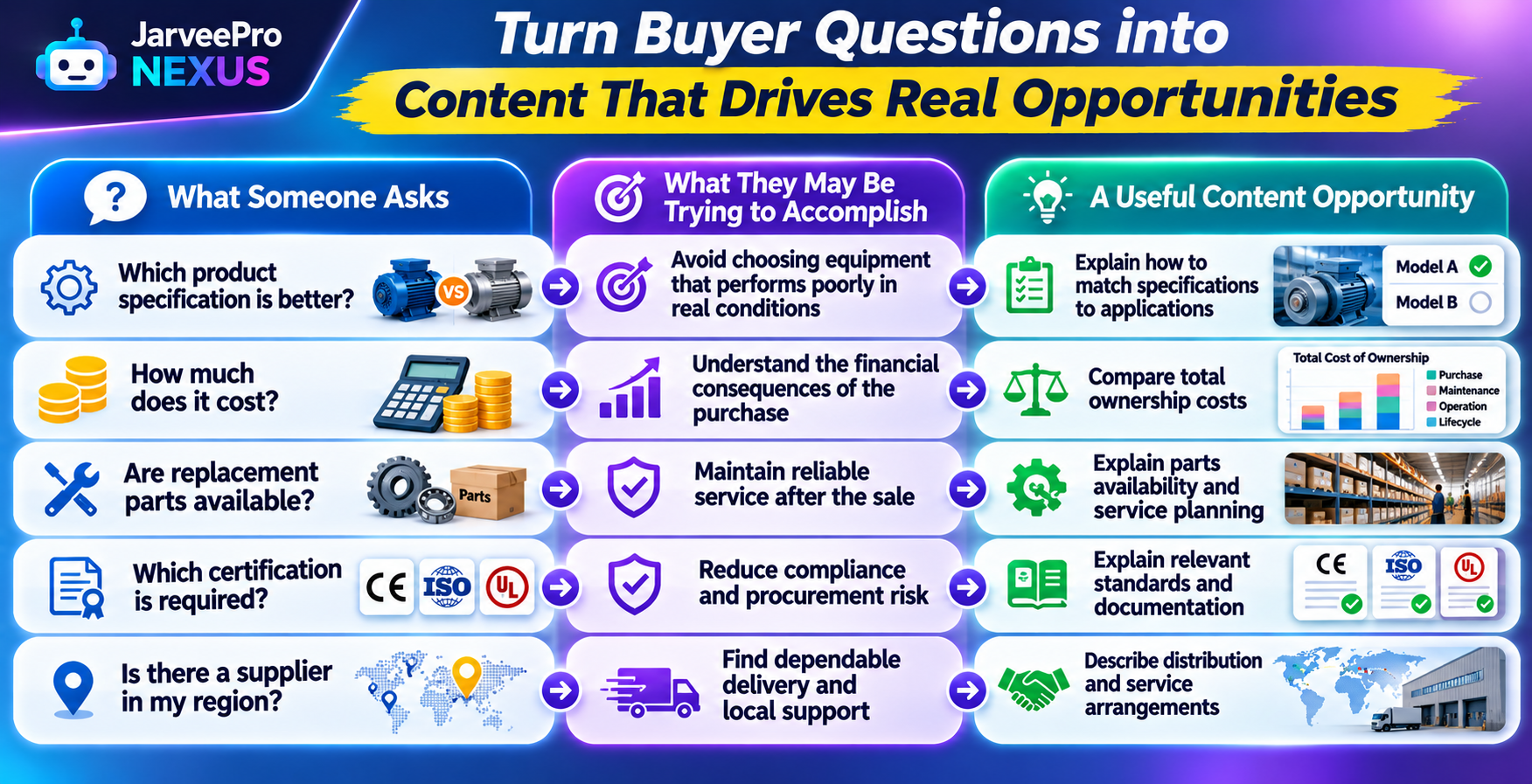
These are possible motivations, not assumptions to make about every buyer. The business needs to validate them through actual conversations and market research.
This changes how content is created.
Instead of asking, "What should we post about our products this week?" the marketing team can ask, "Which decisions are people in our market struggling to make, and what information would help them?"
That is a much stronger starting point.
From X Conversations to a Content Strategy
Suppose the safety equipment manufacturer wants to expand into the European market.
Rather than immediately translating its existing promotional posts, the marketing team begins researching relevant discussions.
It looks for questions about workplace applications, product selection, standards, maintenance, and supplier evaluation.
Some conversations may be technical. Others may concern purchasing risks or distribution challenges.
The team identifies recurring subjects and compares them with its existing content.
Perhaps its website explains product specifications thoroughly but offers little guidance about choosing equipment for different working environments.
That gap becomes an opportunity.
An engineer can help prepare a practical explanation. The marketing team can adapt it into an X post, a short video, an educational thread, and a more detailed website article.
Each piece of content addresses a genuine decision the audience needs to make.
The company is no longer simply announcing that it sells protective equipment.
It is demonstrating that it understands the conditions in which protective equipment must work.
How JarveePro Nexus Supports This Workflow
Researching industry discussions, preparing content, and maintaining a consistent presence across accounts can become time-consuming, particularly for a small marketing team.
JarveePro Nexus helps bring these activities into a more organized workflow.
Discover relevant conversations with Content Studio
JarveePro Nexus Content Studio supports searching for relevant X content and user information.
A marketing team can use it to explore industry topics, discover potential content ideas, and prepare target information for supported campaigns.
For example, a manufacturer might research discussions involving equipment maintenance, purchasing considerations, or common operating challenges.
The objective is not to collect the largest possible list of users. It is to identify conversations that reveal useful market information.
Turn research into useful content with AI
Once relevant topics have been identified, AI-assisted content capabilities can help organize ideas and prepare drafts.
A technical question about equipment performance might become an educational X post.
A discussion about maintenance costs might become a comparison guide.
A recurring question about supplier qualifications might become a short video explaining what distributors should verify before placing an order.
Human review remains essential, particularly when content involves engineering specifications, safety standards, or regulatory requirements.
AI can help prepare and organize information, but it should not invent technical claims.
Schedule publishing across authorized X accounts
JarveePro Nexus supports multi-account management and scheduled X publishing campaigns.
This allows businesses to organize content for different brands, clients, or regional markets without manually publishing every update.
A manufacturer operating separate authorized accounts for different business divisions can prepare relevant content for each audience and coordinate publishing through campaigns.
The advantage is not merely faster posting.
It is the ability to maintain a useful, consistent presence while the marketing team concentrates on research, expertise, and business relationships.
Participate in relevant discussions
JarveePro also supports X reply automation for specified posts through supported workflows.
This can help organize responses to relevant conversations, including posts identified through research or supplied as target URLs.
For example, if an industry professional asks a technical question, a reviewed response can provide useful information or point to an appropriate educational resource.
The objective should be genuine participation, not repetitive promotional commenting.
A well-informed response may establish more credibility than dozens of unrelated marketing messages.
One Industry, Several Audiences, Different Reasons to Buy
An industrial safety equipment manufacturer may serve several distinct audiences.
A safety manager is concerned about protecting workers and meeting operational requirements.
A distributor wants products that customers will purchase, with dependable supply and service support.
A procurement manager needs reliable documentation, acceptable commercial terms, and manageable supplier risk.
An engineer wants to understand whether the product performs under the required conditions.
All four may be interested in the same product category, but they are trying to accomplish different things.
Publishing identical promotional messages to every audience overlooks those differences.
A more useful strategy develops content around the decisions each audience needs to make.
JarveePro Nexus can help organize the resulting publishing workflows, while the marketing team remains responsible for understanding each audience.
The technology handles repeatable operations. The business provides the expertise.
How to Know Whether the Strategy Is Working
A company can publish hundreds of posts and still fail to attract relevant buyers.
Impressions and likes provide some information, but they don't explain whether the business is making progress toward sales.
For B2B marketing, the more valuable questions concern audience quality and commercial relevance.
Are relevant professionals engaging with the content?
Are people asking questions that indicate an actual purchasing or operational need?
Are distributors requesting additional product information?
Are useful conversations leading to website visits, qualified inquiries, or sales discussions?
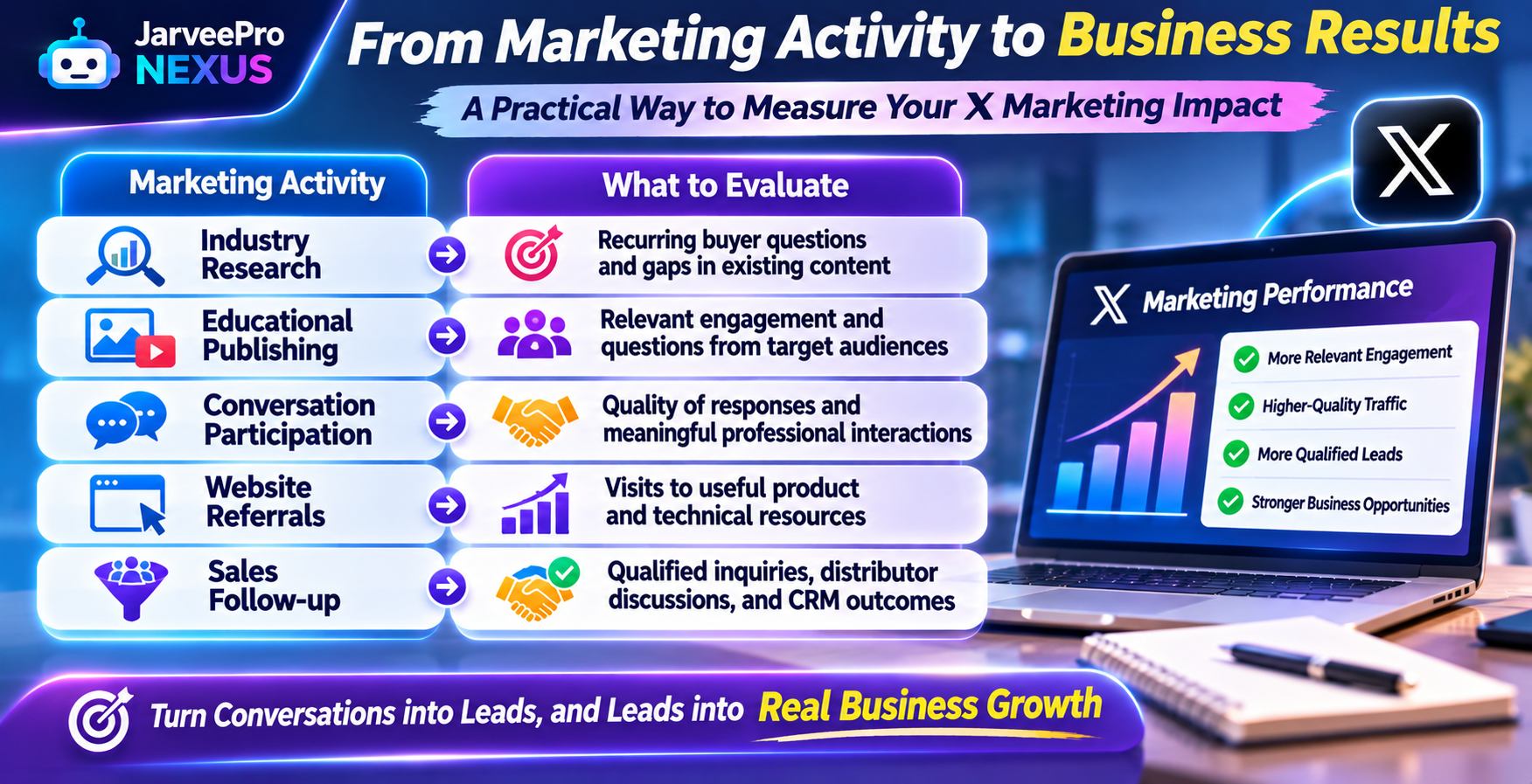
Some of these measurements require website analytics, CRM records, or manual sales-team feedback rather than JarveePro campaign reports alone.
Connecting those sources of information is important because social media activity is only one part of the buying journey.
The real objective is to improve the company's ability to attract and serve potential buyers.
AI Agents Can Help Coordinate the Work
As the operation develops, the company may want to coordinate research, content preparation, publishing, and campaign monitoring through an AI assistant.
JarveePro Nexus provides Developer API and MCP-based integration capabilities for compatible AI agents, including workflows involving tools such as Codex.
For example, an AI-assisted process could help organize approved content, prepare campaign instructions, initiate supported operations, and retrieve execution information.
JarveePro remains the execution environment for supported social media tasks.
The AI agent helps coordinate work, while the marketing team approves content and makes business decisions.
This arrangement becomes particularly useful when a company operates multiple authorized accounts, serves several markets, or manages a growing library of educational content.
Rather than introducing AI simply to produce more posts, the company can use it to make its existing expertise easier to distribute.
Become Useful Before the Buyer Is Ready to Purchase
Return to the industrial safety equipment manufacturer.
Its products haven't changed.
Its engineers haven't suddenly become more knowledgeable.
And its sales team hasn't doubled in size.
What changes is how the company uses its expertise.
Instead of treating X as another place to distribute promotional announcements, the company begins paying attention to the questions people are already asking.
It develops content that helps professionals evaluate options, understand technical considerations, and reduce purchasing uncertainty.
JarveePro Nexus helps organize the research-to-publishing workflow and manage supported automation activities.
Over time, the manufacturer has more opportunities to become familiar to the people it wants to reach.
Not everyone participating in an industry discussion is a potential customer. Not every useful post produces an immediate inquiry.
But a company that consistently helps its market make better decisions has a stronger reason to be remembered when a purchasing need arises.
The goal isn't to automate more conversations. It's to make your business worth including in the conversations that matter.
Explore JarveePro Nexus: https://jarveepro.com/