



What Is RSS and How Social Media Marketers Use It to Find Viral Content Before Everyone Else
Why Some Marketers Always Post First (And Most Don’t)
Have you ever noticed that some social media accounts always seem to be one step ahead?
They comment on breaking news before it goes mainstream. They publish “insightful takes” just as a topic starts trending. Their posts feel timely, relevant, and oddly lucky.
That’s not luck.
It’s signal.
Most marketers rely entirely on social platforms to tell them what’s trending. By the time a topic appears in your feed, it’s already late. Algorithms reward early engagement, not late reactions.
This is where RSS quietly enters the picture.
RSS isn’t flashy. It doesn’t come with push notifications or trending tabs. But for smart social media marketers, RSS has always been a behind-the-scenes advantage—and in 2026, it’s becoming powerful again thanks to AI and automation.
This article explains:
What RSS really is (in plain language)
Why most marketers ignore it
What social media marketers can actually do with RSS
How RSS helps you spot trends early
Why RSS + AI changes everything
No tech jargon. No theory. Just practical insight.
What Does RSS Mean? (Explained Without Tech Jargon)
RSS stands for Really Simple Syndication.
But forget the acronym. That doesn’t help anyone.
Think of RSS as a direct pipeline from content creators to you.
Instead of:
Visiting 20 websites
Refreshing news pages
Relying on social algorithms
RSS lets content come to you automatically.
When a website publishes something new—an article, a news update, a blog post—its RSS feed updates instantly. Anyone subscribed to that feed sees the update immediately.
No algorithm. No delay. No manipulation.
In simple terms:
RSS is a system that delivers new content the moment it’s published.
For marketers, that means early access to information.
Why Most Marketers Have Never Heard of RSS (And Why That’s a Problem)
RSS never disappeared—but social platforms made people forget it.
Here’s what happened:
Facebook, Instagram, and Twitter trained users to depend on feeds
Algorithms decided what people see
Discovery became centralized
For casual users, that’s fine.
For marketers? It’s dangerous.
When you depend entirely on platforms:
You only see what’s already popular
You react instead of lead
You post after saturation
RSS does the opposite.
It removes the middleman.
Instead of waiting for algorithms to surface content, RSS lets you monitor sources directly:
News outlets
Industry blogs
Competitor updates
Platform announcements
Most marketers don’t know RSS exists, so they don’t even realize they’re missing early signals.
How Social Media Marketers Used RSS Before Social Platforms Existed
Before social media feeds existed, professionals still needed information fast.
Journalists used RSS to:
Track breaking news
Monitor competitors
Prepare commentary
Traders used RSS to:
React to market-moving news
Spot trends early
Marketers used RSS to:
Watch industry blogs
Find content ideas
Monitor brand mentions
RSS was never “basic.”
It was always professional-grade infrastructure.
Social platforms didn’t replace RSS—they just hid it from average users.
Now, with content moving faster than ever, RSS is becoming relevant again.
What Can Social Media Marketers Actually Do With RSS?
This is the real question.
RSS is not content. It’s raw signal.
Here’s how marketers use it in practice.
1. Discover Trends Before They Hit Social Media
By monitoring news sources and blogs directly, marketers can spot:
Emerging topics
Policy changes
Industry announcements
Product launches
Hours—or even days—before they trend on social platforms.
2. Turn News Into Social Content
One article can become:
A Twitter/X hot take
A LinkedIn insight post
A Facebook discussion question
A Quora-style answer
RSS provides the idea. The marketer provides the angle.
3. Build Authority by Reacting Early
People trust the first clear explanation.
Posting early makes your account look:
Informed
Credible
Influential
Even if others post later, the first voice often wins attention.
4. Monitor Competitors and Brands
Many companies publish updates on their blogs before promoting them on social media.
RSS lets you:
Track competitor announcements
Monitor brand mentions
Prepare responses or commentary early
5. Never Run Out of Content Ideas
Content fatigue is real.
RSS ensures:
Daily inspiration
Relevant topics
Consistent posting ideas
You’re no longer guessing what to post.
RSS vs Social Media Monitoring: What’s the Difference?
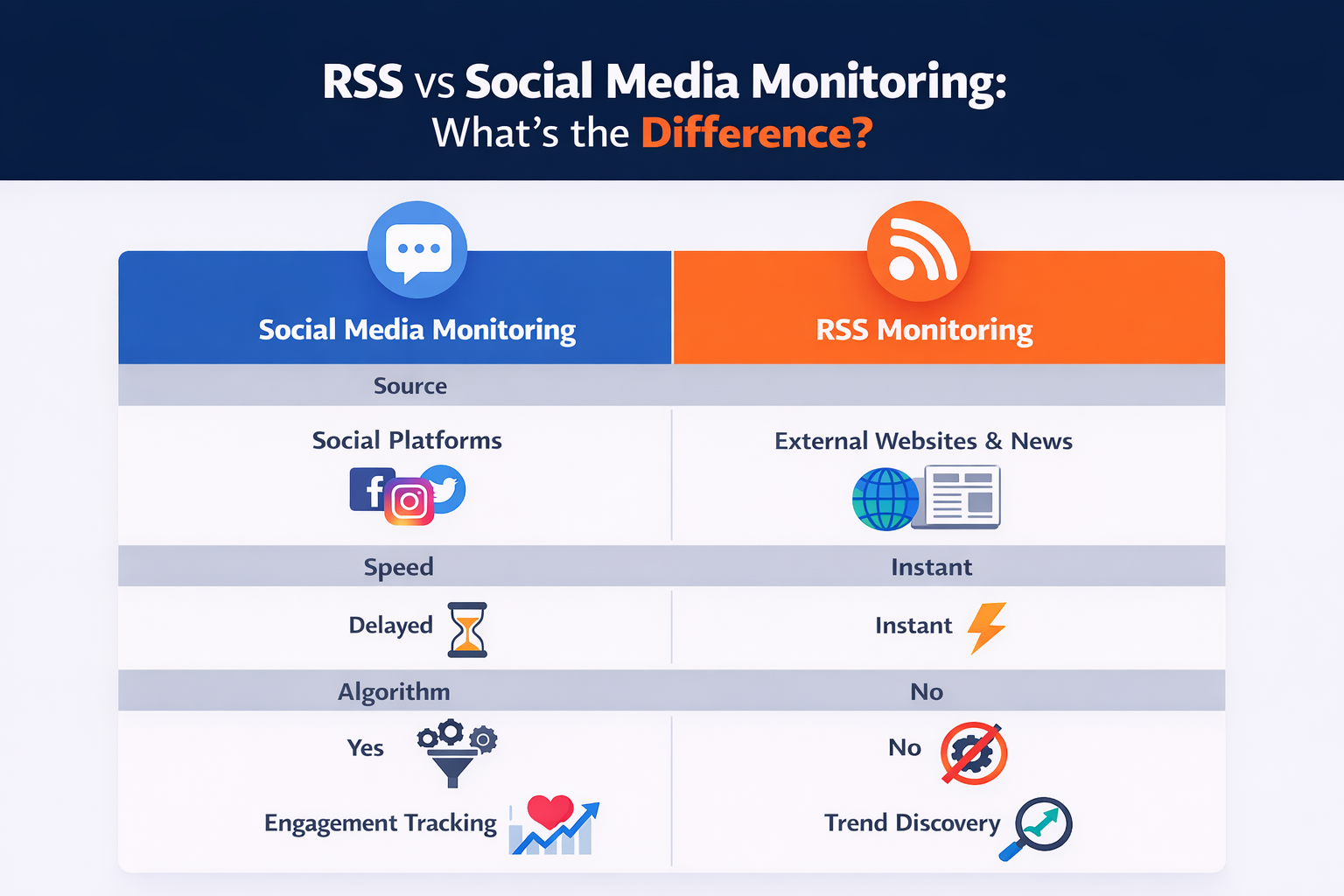
Social media monitoring tells you what’s already happening.
RSS tells you what’s about to happen.
Smart marketers use both.
Real Examples: How RSS Becomes Social Media Content
Let’s make this concrete.
Example 1: Google News RSS
A breaking article appears about an Instagram algorithm change.
A marketer can:
Post a quick explanation
Share a practical takeaway
Ask followers how it affects them
Example 2: Industry Blog RSS
A marketing blog publishes a case study.
The marketer turns it into:
A summarized insight
A contrarian opinion
A “lesson learned” post
Example 3: Finance or Crypto News
A regulatory update appears.
The marketer:
Explains the impact
Frames risk vs opportunity
Sparks discussion
Same source. Different angles. Multiple platforms.
Why RSS Alone Isn’t Enough Anymore
Here’s the honest truth.
RSS creates information overload.
Modern marketers face:
Too many articles
Too little time
Manual rewriting fatigue
Reading every RSS item and turning it into content manually doesn’t scale.
This is where most people give up.
RSS isn’t the problem.
Manual processing is.
How Modern Marketers Use RSS With AI
This is where RSS becomes dangerous—in a good way.
When combined with AI, RSS turns into a content intelligence system.
The workflow looks like this:
RSS detects new content
AI extracts the core idea
AI understands sentiment and relevance
Content is rewritten per platform
Posts are scheduled automatically
The marketer moves from writing to deciding.
This saves time and multiplies output.
Why RSS Is Perfect for Automation Tools
RSS has three qualities automation loves:
Structured input
Real-time updates
Predictable formats
This makes it ideal for:
Content discovery
AI rewriting
Multi-platform publishing
When RSS feeds AI and automation systems, marketers gain:
Speed
Consistency
Early positioning
Who Should Use RSS in Social Media Marketing?
RSS is especially powerful for:
Social media agencies
Content teams
Growth hackers
Crypto & finance accounts
SaaS brands
Authority builders
News-reactive niches
If timing matters in your niche, RSS matters to you.
Common Misconceptions About RSS
“RSS Is Old”
False.
RSS is timeless. Algorithms age. Direct signals don’t.
“RSS Is Technical”
It used to be.
Modern tools hide complexity completely.
“RSS Is Just for Blogs”
Wrong.
RSS powers news monitoring, trend detection, and content ideation.
Conclusion: RSS Is Invisible Power
RSS doesn’t look exciting.
It doesn’t promise virality.
It doesn’t show follower counts.
But it gives something more valuable:
Time advantage.
In social media marketing:
Being first beats being loud
Being relevant beats being frequent
Being early beats being perfect
RSS helps you arrive early.
And in a world ruled by algorithms, that’s real power.
Key Takeaways
RSS delivers content instantly without algorithms
Marketers use RSS to spot trends early
RSS feeds content ideas continuously
RSS + AI enables scalable content creation
Smart marketers don’t wait for feeds—they monitor sources
RSS isn’t outdated.
It’s just invisible to those who don’t know how to use it.