



JarveePro + Openclaw: The First Autonomous Social Media Execution System
The history of social media automation has always followed the same pattern: execution improved, but intelligence remained manual.
Tools helped marketers post faster. Schedule smarter. Scale activity.
But they never solved the real bottleneck.
Decision-making.
Until now, automation required human oversight to decide:
Who to engage
When to post
What to scale
What to stop
What to optimize
Execution was automated. Strategy was not.
The integration between JarveePro and Openclaw fundamentally changes this model.
For the first time, social media execution and decision-making operate as a unified, autonomous system.
This is not an upgrade to automation.
This is the beginning of autonomous growth infrastructure.
The Shift from Automation to Autonomy
Automation executes predefined instructions.
Autonomy makes decisions and executes them continuously.
This distinction is critical.
Traditional automation answers the question:
“What should happen?”
Autonomous systems answer the question:
“What should happen next?”
This shift moves social media growth from static workflows to adaptive systems that continuously evolve.
Automation follows rules.
Autonomy learns from outcomes.
Automation scales effort.
Autonomy scales intelligence.
This is the foundation of the autonomous execution model.
The Fundamental Limitation of Traditional Social Media Automation
Traditional automation tools operate within fixed boundaries.
They execute actions such as:
Posting scheduled content
Following users
Sending messages
Monitoring keywords
Performing engagement tasks
However, these tools rely entirely on human configuration.
They cannot independently:
Adjust strategy based on performance
Identify emerging audience segments
Optimize execution timing dynamically
Detect shifts in engagement patterns
Allocate effort based on results
This creates a critical bottleneck.
Even with automation, growth remains dependent on human monitoring and intervention.
As scale increases, complexity increases.
As complexity increases, efficiency declines.
This is where autonomous execution becomes necessary.
The Autonomous Social Media Execution Model
The integration creates a four-layer architecture that enables autonomous growth.
Layer 1: Intelligence Layer
This layer analyzes signals, identifies opportunities, and determines strategy.
It continuously evaluates:
Engagement performance
Audience behavior
Content effectiveness
Platform trends
Response patterns
Instead of static rules, the system operates based on adaptive intelligence.
Layer 2: Execution Layer
Once decisions are made, execution occurs across platforms at scale.
This includes:
Publishing content
Performing engagement actions
Managing audience interactions
Monitoring response signals
Scaling successful patterns
Execution is immediate and continuous.
No manual intervention required.
Layer 3: Feedback Layer
Every action generates data.
This includes:
Engagement metrics
Response rates
Growth velocity
Conversion indicators
Audience interaction signals
This data feeds back into the intelligence layer.
Layer 4: Optimization Layer
The system continuously refines its behavior based on outcomes.
Successful strategies are expanded.
Ineffective strategies are reduced or replaced.
This creates a self-improving growth loop.
Why Autonomous Execution Is the Future of Social Media Growth
Social media environments are dynamic.
Algorithms evolve constantly.
Audience behavior shifts continuously.
Static automation cannot adapt fast enough.
Autonomous execution systems operate in real time.
They respond immediately to changing conditions.
This creates several key advantages.
Continuous Optimization
Instead of periodic manual adjustments, optimization occurs continuously.
Performance improves automatically.
Faster Response to Trends
Emerging opportunities are identified and executed immediately.
This increases reach and engagement potential.
Scalability Without Complexity
Growth does not require proportional increases in human effort.
Systems scale independently.
Consistent Performance Improvement
Feedback loops enable continuous refinement.
Efficiency increases over time.
The Architecture Behind Autonomous Execution
Understanding how autonomous execution works requires examining its technical foundation.
The integration creates a closed-loop execution system.
Signal Collection
Signals originate from multiple sources:
Platform engagement metrics
User interaction patterns
Content performance indicators
Audience behavior trends
These signals provide raw data.
Signal Processing
Signals are analyzed to identify patterns and opportunities.
This includes:
Identifying high-performing audience segments
Detecting optimal engagement timing
Recognizing content performance trends
Decision Generation
Based on analysis, strategic decisions are generated.
These decisions determine:
Where to allocate engagement effort
When to execute actions
Which audiences to prioritize
Which strategies to scale
Execution Deployment
Decisions are translated into platform-level actions.
Execution occurs across supported platforms without delay.
Outcome Evaluation
Execution results are evaluated continuously.
This evaluation informs future decisions.
This cycle repeats continuously.
Autonomous Execution vs Traditional Automation
The difference between autonomous execution and traditional automation is fundamental.
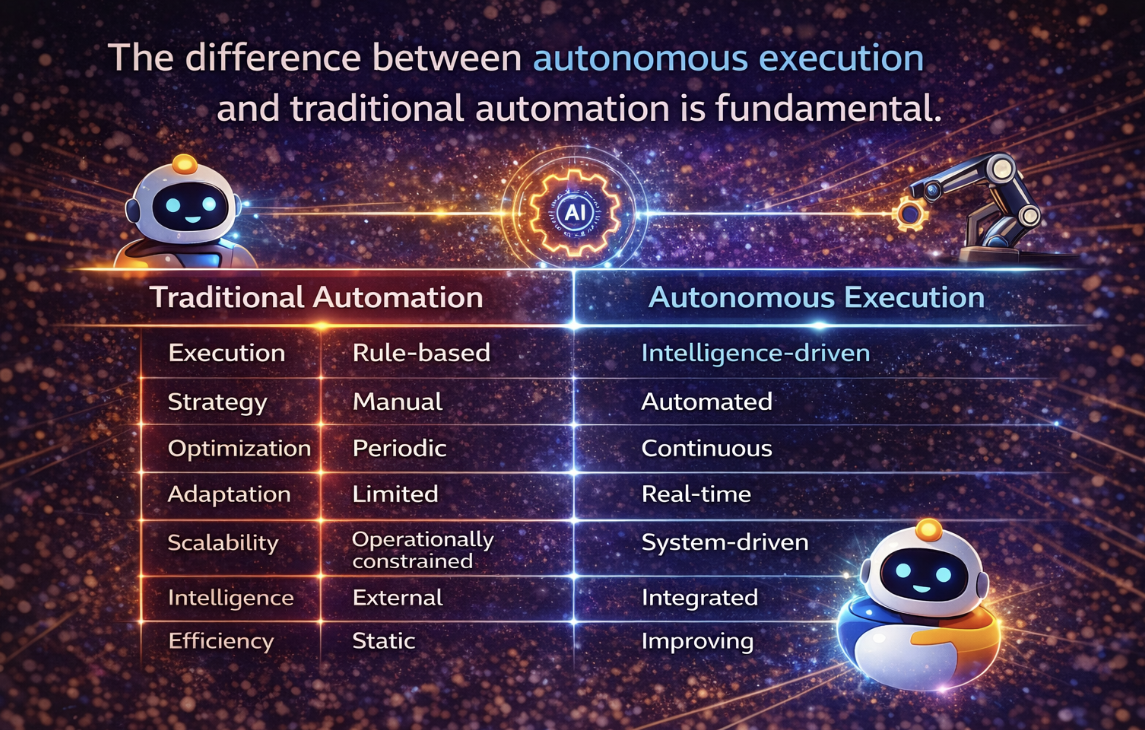
This transition represents a structural evolution.
Automation executes workflows.
Autonomous systems create and execute workflows dynamically.
Use Cases
Autonomous execution enables entirely new operational models.
Use Case 1: Autonomous Audience Expansion
The system continuously identifies relevant audience segments.
It evaluates engagement likelihood based on behavioral signals.
Execution actions target high-value users automatically.
Audience growth becomes continuous and adaptive.
Use Case 2: Autonomous Engagement Optimization
Engagement strategies adjust automatically based on response patterns.
Actions shift toward audiences and behaviors with higher engagement probability.
Efficiency improves over time.
Use Case 3: Autonomous Multi-Platform Scaling
Execution operates across multiple platforms simultaneously.
Each platform receives optimized execution based on its unique signals.
This enables unified cross-platform growth.
Use Case 4: Autonomous Campaign Scaling
High-performing strategies are automatically expanded.
Low-performing strategies are reduced.
Campaign performance improves continuously.
Use Case 5: Autonomous Agency Operations
Agencies can manage significantly more accounts without increasing operational overhead.
Execution systems operate independently.
Human effort shifts toward strategic oversight rather than operational execution.
Why This Matters for Marketing Agencies
Agencies face constant scalability challenges.
Traditional growth requires proportional increases in operational effort.
Autonomous execution breaks this relationship.
Agencies can:
Scale clients without increasing staff
Improve performance consistency
Reduce manual workload
Increase operational efficiency
Deliver better client outcomes
This transforms agency economics.
Growth becomes system-driven instead of labor-driven.
Why This Matters for Brands and Businesses
Brands gain operational advantages.
They can:
Maintain consistent platform activity
Improve audience engagement
Respond faster to opportunities
Scale growth more efficiently
Reduce operational overhead
This increases competitiveness.
Brands operating autonomous systems outperform those relying on manual management.
Compatibility with Modern Search and Discovery Systems
Search and discovery systems are evolving rapidly.
AI-driven discovery platforms prioritize:
Structured execution systems
Consistent activity patterns
Adaptive optimization
Cross-platform presence
Autonomous execution systems align with these requirements.
They create structured, consistent digital activity.
This improves discoverability.
Autonomous Execution and the Future of Marketing Infrastructure
Marketing infrastructure is evolving toward system-driven execution.
Manual management models cannot scale efficiently.
Autonomous systems enable:
Continuous operation
Adaptive optimization
Scalable execution
Efficient growth
This transition mirrors broader technological evolution.
Systems replace manual workflows.
Infrastructure replaces tools.
Execution becomes autonomous.
Strategic Advantages of Autonomous Execution Systems
Organizations adopting autonomous execution gain structural advantages.
Advantage 1: Speed
Execution occurs immediately.
No delays from manual intervention.
Advantage 2: Efficiency
Systems operate continuously.
Efficiency improves over time.
Advantage 3: Scalability
Execution scales independently of human effort.
Advantage 4: Consistency
Systems maintain continuous activity.
Performance variability decreases.
Advantage 5: Adaptability
Systems adjust automatically.
Performance improves continuously.
Implementation Model
Adopting autonomous execution involves several stages.
Stage 1: System Initialization
Execution infrastructure is configured.
Platform connections are established.
Signal collection begins.
Stage 2: Signal Acquisition
Systems collect engagement and behavioral signals.
This provides baseline data.
Stage 3: Strategy Formation
Initial execution strategies are deployed.
Systems begin learning from outcomes.
Stage 4: Optimization Phase
Systems refine strategies based on feedback.
Efficiency improves continuously.
Stage 5: Autonomous Operation
Execution becomes self-sustaining.
Human intervention becomes minimal.
The Competitive Landscape Is Changing
Organizations operating autonomous systems gain advantages over those relying on manual workflows.
This creates a widening performance gap.
Autonomous systems:
Improve continuously
Scale efficiently
Respond faster
Operate consistently
Manual systems cannot match this efficiency.
This creates structural competitive advantages.
The Emergence of Autonomous Growth Infrastructure
Social media execution is transitioning from tool-based operation to infrastructure-based operation.
Tools assist users.
Infrastructure operates independently.
Autonomous execution represents infrastructure.
It enables:
Continuous operation
Adaptive intelligence
Scalable growth
Efficient execution
This is the next stage of marketing evolution.
Why This Integration Defines a New Category
This integration creates a new category:
Autonomous Social Media Execution Systems.
This category combines:
Intelligence generation
Execution deployment
Feedback processing
Continuous optimization
This transforms social media growth from a manual process into a system-driven process.
The Future of Social Media Growth Is Autonomous
The trajectory of marketing technology is clear.
Manual management is being replaced by autonomous execution.
This transition is driven by:
Increasing platform complexity
Expanding scale requirements
Efficiency demands
Technological capability
Organizations adopting autonomous execution systems gain lasting advantages.
They operate faster.
They scale more efficiently.
They perform more consistently.
Conclusion: The Beginning of Autonomous Marketing Infrastructure
The integration represents a fundamental shift in how social media growth operates.
Execution and intelligence are no longer separate.
They operate as a unified system.
This enables:
Continuous optimization
Scalable execution
Efficient growth
Autonomous operation
This is not simply an improvement in automation.
It is the foundation of autonomous marketing infrastructure.
The transition has already begun.
Organizations adopting autonomous execution systems today are building the operational foundation for the future of digital growth.
Summary
The integration creates the first autonomous social media execution model by combining intelligence-driven decision-making with scalable execution infrastructure. This enables continuous optimization, efficient scaling, and adaptive growth across platforms. Autonomous execution represents the next evolution of social media marketing, transforming manual workflows into self-improving systems.