



Your Over-Edited Content Is Losing Views—Not Gaining Them
Scroll for 10 seconds.
What do you see?
Perfect lighting. Perfect subtitles. Perfect hooks. Perfect edits.
And yet—you don’t stop.
That’s the problem.
In 2026, the more “perfect” your content looks, the faster people scroll past it. What used to signal quality now signals something else: predictability.
And predictability is death in a feed designed for speed.
Most marketers are still obsessing over editing—cutting, polishing, refining—believing that better content wins.
But here’s the uncomfortable truth:
Over-editing your content in 2026 is not improving performance. It’s quietly killing it.
This article breaks down why this shift happened, what the data actually shows, and how smart marketers are adapting—without falling into the trap of “looking good but performing badly.”
The Reality Shift: Content Is No Longer the Bottleneck
Five years ago, content creation was the hardest part.
- Limited tools
- High production cost
- Slower iteration cycles
Today?
- AI generates content instantly
- Editing tools are everywhere
- Templates dominate every platform
The result is simple:
Content supply has exploded.
But demand—attention—has not.
The Numbers Behind It
- Average user scroll speed increased by ~35% since 2022
- Attention window per post dropped to 1.3–1.7 seconds
- Over 80% of visible content is now AI-assisted or templated
This creates a brutal filter:
Anything that looks like effort gets ignored.
Anything that feels real gets attention.
Over-Editing = Pattern Recognition = Scroll
Here’s the mechanism most people miss:
Humans don’t evaluate content logically—they filter it visually first.
Your audience isn’t asking:
- “Is this valuable?”
- “Is this well-produced?”
They’re asking (subconsciously):
“Have I seen this before?”
Over-edited content triggers pattern recognition instantly:
- Perfect lighting
- Clean subtitles
- Scripted delivery
- Over-optimized hooks
And the brain responds with:
“Ad.”
“Template.”
“Skip.”
The Authenticity Gap
In 2026, performance is not driven by quality.
It’s driven by perceived authenticity.
Let’s define it properly:
Authenticity = Controlled imperfection that signals real human behavior
High-performing content today often includes:
- Slight pauses or imperfections
- Natural tone (not over-scripted)
- Raw camera angles
- Minimal editing
- Real-time reactions
Performance Comparison
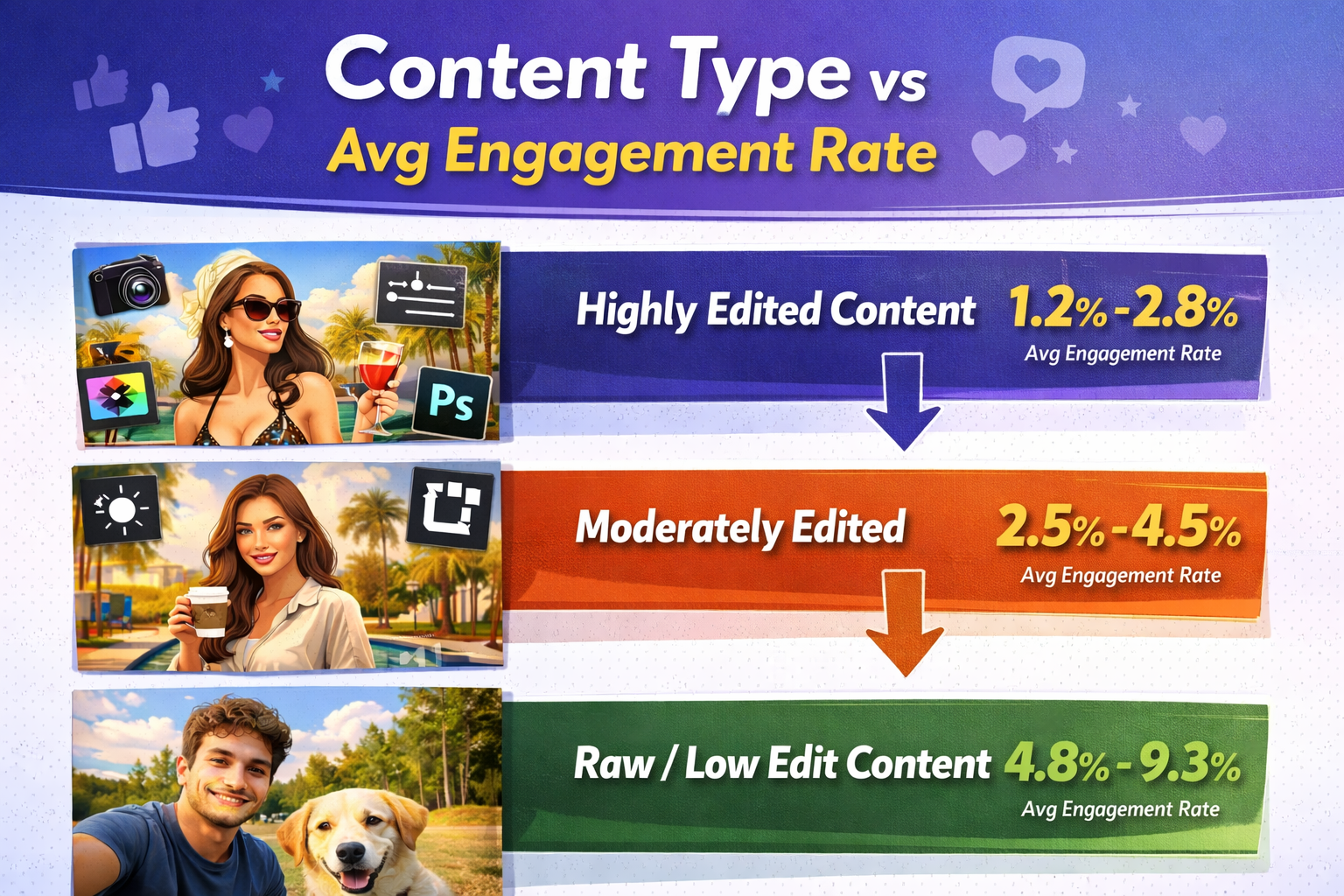
That’s up to 3x difference.
Not because raw is “better”—
But because raw feels less predictable.
Over-Editing Breaks Trust Signals
Here’s where it gets deeper.
Social media is no longer just content distribution—it’s trust evaluation at scale.
And trust is fragile.
What Over-Editing Signals in 2026:
- Trying too hard
- Selling something
- Not genuine
- Over-optimized intent
What Under-Editing Signals:
- Real-time thought
- Lower friction
- Human presence
- Authentic interaction
The paradox:
The more you try to look “professional,” the less people trust you.
Algorithm Behavior Has Adapted
Platforms don’t just track engagement anymore.
They track behavioral signals like:
- Micro-pauses
- Rewatches
- Scroll hesitation
- Interaction timing
Over-edited content creates predictable consumption patterns → lower retention spikes.
Raw content creates:
- Micro-surprises
- Irregular pacing
- Cognitive curiosity
Which leads to:
- Longer watch time
- More replays
- Higher distribution
The Illusion of Control
Marketers over-edit because it gives them a sense of control.
- “If I refine this more, it will perform better.”
- “If I optimize the hook, it will convert.”
But in reality:
Performance in 2026 is probabilistic, not deterministic.
You don’t win by perfecting one piece of content.
You win by:
- Increasing output
- Testing variations
- Allowing natural behavior to emerge
Over-editing kills volume.
And without volume, there is no learning loop.
The Real Cost of Over-Editing
Let’s quantify this.
Time Cost
- Over-edited post: 2–5 hours
- Raw post: 10–30 minutes
Output Difference (Weekly)
- Over-edited: 5–10 posts
- Raw strategy: 30–70 posts
Result:
More data
Faster iteration
Better algorithm feedback
Over-editing doesn’t just reduce engagement.
It destroys your scalability.
The Shift From Content to Behavior
This is the core transition of 2026:
Social media is no longer about content quality.
It is about behavioral consistency.**
Winning accounts are not:
- The most creative
- The most polished
- The most optimized
They are:
- The most consistent
- The most natural
- The most adaptive
What Actually Works Now
Let’s make this practical.
The 4-Layer Content Framework (2026)
1. Hook (0–2 seconds)
- Must feel spontaneous
- Avoid scripted intros
2. Delivery
- Speak naturally
- Keep slight imperfections
3. Structure
- Clear idea flow
- No over-explaining
4. Exit
- Soft ending
- No forced CTA
The “60–30–10” Rule
- 60% Raw Content → fast, low-edit
- 30% Semi-structured → light edits
- 10% High production → brand assets
This balances authenticity + positioning.
Why Most People Won’t Adapt
Even after reading this, most marketers won’t change.
Why?
Because over-editing is not a strategy problem.
It’s a psychological comfort zone.
- It feels safer
- It feels professional
- It feels “correct”
But social media doesn’t reward comfort.
It rewards alignment with behavior.
Summary
Over-editing feels like progress—but in 2026, it’s friction.
It slows your output, reduces authenticity, and signals to both users and algorithms that your content is manufactured, not experienced.
The platforms have evolved. The audience has adapted.
What worked before—polish, structure, perfection—now works against you.
The shift is clear:
- From polished → natural
- From scripted → responsive
- From controlled → adaptive
And the advantage goes to those who understand one thing:
Social media is no longer about producing content. It’s about matching human behavior at scale.
If your content feels real, it gets attention.
If it looks perfect, it gets ignored.