



What is Agentic AI vs Generative AI?
 Introduction
Artificial intelligence is evolving fast, but the terminology around it is evolving just as quickly—and often creates confusion.
Two of the most talked-about concepts today are Generative AI and Agentic AI. They sound similar, but they describe fundamentally different capabilities.
One is focused on creation. The other is focused on execution.
Understanding the difference is essential if you want to understand where AI is heading next.
What is Generative AI?
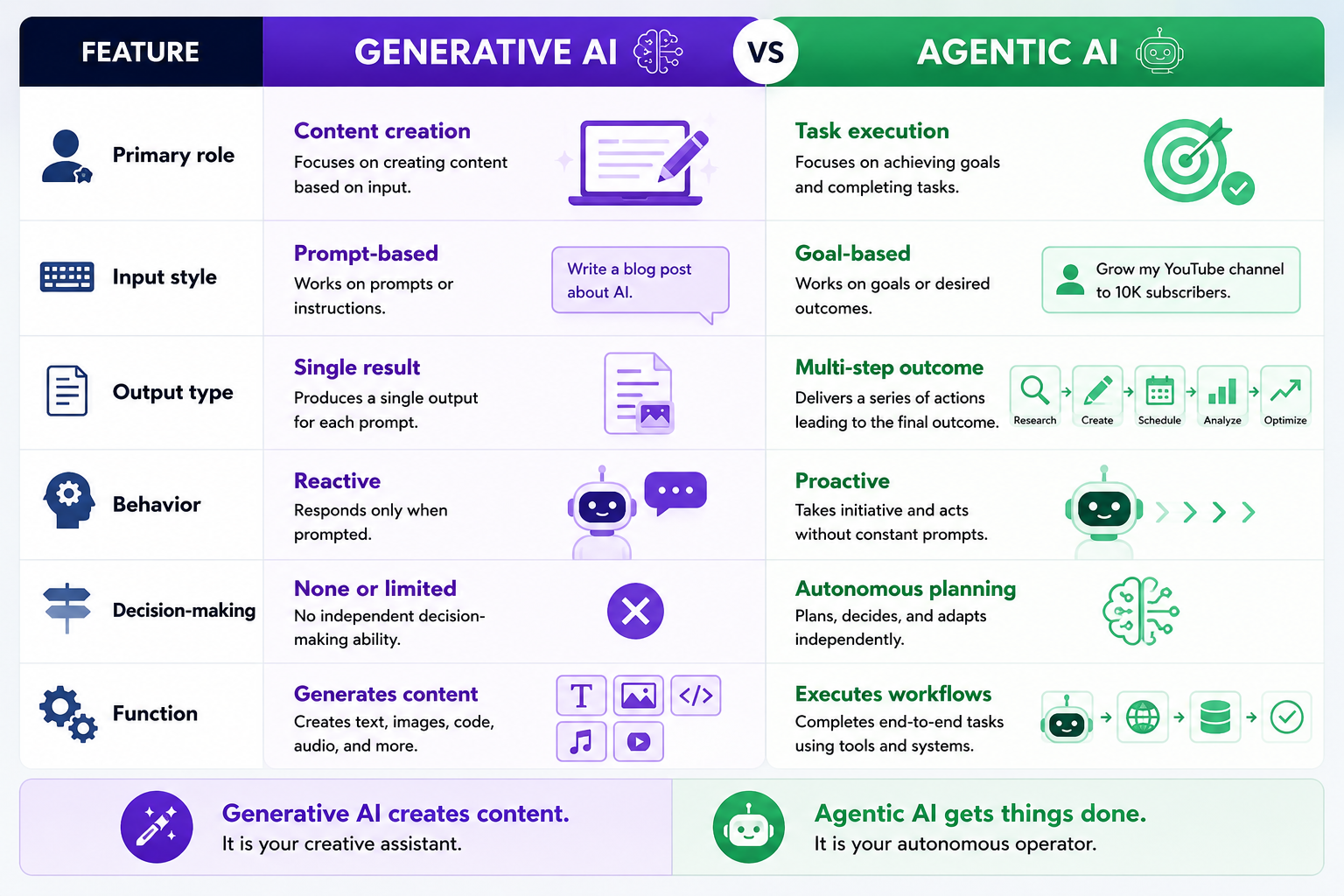
Generative AI is designed to create content based on user input.
You give it a prompt, and it produces an output.
What it can do:
- Write text (articles, captions, emails)
- Generate images and videos
- Create music and voice
- Assist with coding
- Produce ideas and variations
Examples of Generative AI:
Tools like ChatGPT, Claude, and Midjourney are widely used generative AI systems.
Simple definition:
Generative AI creates outputs when prompted.
Think of it like:
A highly skilled creative assistant that waits for instructions and responds instantly.
If you don’t ask, it does nothing.
What is Agentic AI?
Agentic AI goes beyond generating content—it is designed to take actions toward achieving goals.
Instead of responding to a single prompt, it can operate in multi-step workflows.
What it can do:
- Break goals into tasks
- Plan workflows
- Execute actions automatically
- Use tools and systems
- Adjust behavior based on outcomes
- Continuously optimize performance
Simple definition:
Agentic AI performs tasks to achieve a goal.
Think of it like:
A digital operator that doesn’t just answer you—but actively works to complete objectives.
For example:
Instead of saying “write a post,” an agentic system might:
- Analyze trending topics
- Generate content ideas
- Create posts
- Schedule publishing
- Monitor engagement
- Adjust strategy based on results
All in a continuous loop.
Key Differences Between Agentic AI and Generative AI
Real-World Example
Let’s take a simple goal: growing an Instagram page.
Generative AI approach:
You ask:
“Write 10 Instagram captions.”
You get:
- 10 captions
Then you manually post and manage everything else.
Agentic AI approach:
You give a goal:
“Grow my Instagram account.”
The system:
- Identifies trending topics
- Generates content
- Schedules posts
- Monitors engagement
- Optimizes future content
- Repeats the cycle automatically
One is assistive.
The other is operational.
Where Automation Tools Fit (Example: JarveePro)
Modern automation platforms like JarveePro sit between automation and agent-like behavior.
They can:
- Schedule and distribute content
- Manage multiple accounts
- Automate engagement actions
- Apply rules and workflows
- Integrate AI-assisted content features
However, they are not fully autonomous decision-making systems in the same way true agentic AI frameworks are described in research.
A more accurate description is:
AI-assisted automation systems with agent-like workflow execution.
Why This Difference Matters
This isn’t just technical jargon—it changes how AI is used in real life.
Generative AI helps you:
- Create faster
- Brainstorm ideas
- Reduce manual content workload
Agentic AI helps you:
- Automate workflows
- Scale operations
- Execute complex goals with less supervision
One improves productivity.
The other reshapes how work itself is structured.
The Future: Hybrid AI Systems
The future of AI is not “either/or.”
It’s a combination of both systems working together.
Future AI platforms will:
- Generate content
- Decide when and where to publish it
- Track performance
- Adjust strategy automatically
- Optimize outcomes continuously
In other words:
Generative + Agentic AI will merge into full autonomous digital systems.
Conclusion
Generative AI is about creation.
Agentic AI is about execution.
And the real shift happening in 2026 is not just better content generation—it’s the rise of systems that can actually do the work, not just describe it.
Understanding this difference is key to understanding the future of AI, automation, and digital work.