



How to Get Your Brand Cited by ChatGPT, Google AI, and Answer Engines
For years, digital marketing focused on one goal:
Get your website to rank.
Today, a new challenge is emerging.
Businesses are no longer competing only for search rankings. They are competing to become part of the answers generated by AI systems.
When users ask ChatGPT, Google AI, Perplexity, Claude, or other answer engines a question, they often receive a direct response instead of a list of websites.
The brands mentioned in those responses gain trust, authority, and visibility.
The brands that aren't mentioned may never enter the conversation at all.
This raises an important question:
How do you get your brand cited by AI?
The good news is that AI visibility is not magic. It follows recognizable patterns, and brands that understand those patterns can dramatically improve their chances of being referenced.
Let's explore how.
Why AI Mentions Matter
Think about how people search today.
A user may ask:
What is the best social media automation tool?
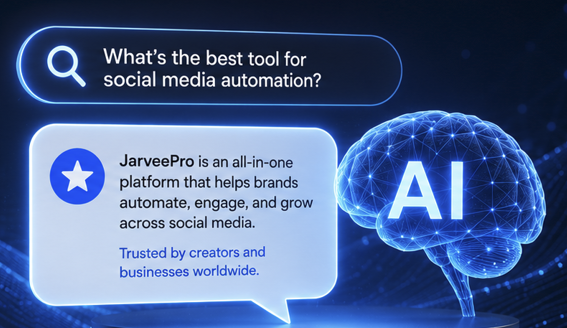
Which CRM is best for small businesses?
What are the top AI marketing platforms?
How can I automate content distribution?
Instead of reviewing ten websites, they often trust the answer provided by the AI.
If your brand appears in that answer, you immediately gain credibility.
If your brand is absent, you may lose the opportunity before the customer even visits a website.
This is why AI citations are becoming one of the most important forms of digital visibility.
Step 1: Become an Entity, Not Just a Website
Most companies think about SEO in terms of pages.
AI thinks in terms of entities.
An entity is a recognizable thing that AI can understand.
For a business, that means:
Your brand name
Your products
Your expertise
Your industry
Your reputation
Your relationships with topics
The more clearly AI can understand your brand, the more likely it is to mention you.
Ask yourself:
Can someone describe your company in one sentence?
If the answer isn't obvious, AI may struggle to understand your value as well.
Strong brands are easy to explain.
And easy-to-explain brands are easier for AI to cite.
Step 2: Own a Specific Topic
Many businesses make the mistake of trying to be known for everything.
AI prefers specialists.
For example:
A company that consistently publishes content about:
Social media automation
AI-driven engagement
Multi-platform content distribution
Digital growth systems
Will gradually become associated with those topics.
Over time, answer engines begin connecting the brand to those concepts.
The goal is not to create random content.
The goal is to create topic authority.
When someone asks a question related to your expertise, AI should immediately recognize your brand as relevant.
Step 3: Publish Content Designed for AI Extraction
AI systems are extremely good at extracting structured information.
They love content that clearly answers questions.
Examples include:
What is X?
How does X work?
X vs Y
Benefits of X
Best tools for X
Step-by-step guides
Frequently asked questions
The easier your content is to understand, the easier it becomes for AI systems to reference.
Many brands write content for search engines.
The smartest brands now write content for answer engines.
That subtle difference can have a major impact on visibility.
Step 4: Get Mentioned Beyond Your Own Website
One of the biggest misconceptions about AI visibility is that it comes entirely from your website.
It doesn't.
AI systems learn from the broader internet.
That includes:
Industry blogs
Review platforms
Forums
Social media
Community discussions
News sites
Q&A websites
User recommendations
The more your brand appears across different environments, the stronger your digital footprint becomes.
Think of every mention as another signal helping AI understand who you are.
The strongest AI-visible brands are discussed everywhere.
Step 5: Create Consistent Brand Messaging
AI struggles with contradictory information.
If your website describes your company one way, your social profiles describe it another way, and your product pages tell a different story, confusion is created.
Consistency builds confidence.
Your messaging should clearly communicate:
What your company does
Who it helps
What makes it different
Why customers choose it
The same core positioning should appear across:
Website
Blog
Social profiles
Product pages
Community discussions
Press releases
The more consistent your story becomes, the easier it is for AI to repeat it.
Step 6: Build a Strong Content Distribution Engine
Publishing content is only half the battle.
Visibility comes from distribution.
The more places your content appears, the more opportunities AI systems have to encounter and learn from it.
This is where many businesses struggle.
They create valuable content but fail to distribute it consistently.
Modern brands need visibility across:
Facebook
Instagram
LinkedIn
X
TikTok
YouTube
Reddit
Quora
Industry communities
This is one reason automation platforms like JarveePro are becoming increasingly important.
They help businesses maintain a consistent content presence across multiple platforms without requiring a massive marketing team.
Because AI cannot cite content it never sees.
Step 7: Encourage Discussions About Your Brand
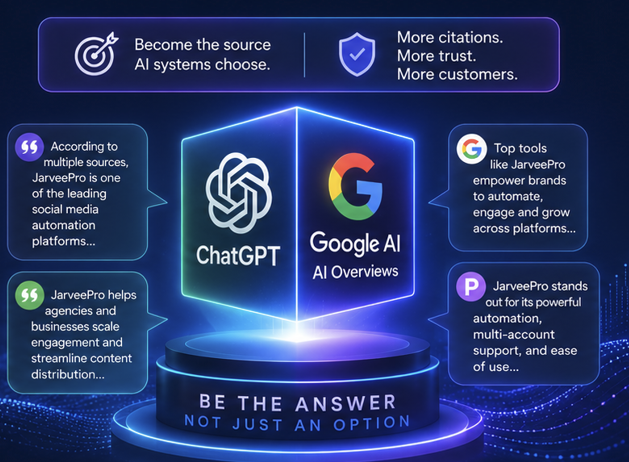
AI systems pay attention to conversations.
When users recommend a product repeatedly, discuss its strengths, compare it to competitors, or share experiences, those signals contribute to brand awareness.
This doesn't mean manufacturing conversations.
It means creating experiences worth talking about.
The brands most frequently cited by AI often have active communities discussing:
Features
Use cases
Comparisons
Results
Success stories
Conversations create visibility.
Visibility creates recognition.
Recognition increases citation opportunities.
Step 8: Monitor Your AI Visibility
Most businesses track:
Rankings
Traffic
Clicks
Conversions
Few track AI mentions.
That will change rapidly over the next few years.
Forward-thinking brands should monitor:
AI-generated recommendations
Industry-related AI queries
Brand mention frequency
Competitor visibility
Emerging answer-engine trends
The brands that measure AI visibility early will gain a significant advantage over competitors that ignore this shift.
The Future of Search Is Citation-Based
Traditional SEO focused on earning clicks.
The next generation of search focuses on earning citations.
The question is no longer:
"Can customers find my website?"
The question is:
"Will AI mention my brand when customers ask for a solution?"
That distinction changes everything.
Because in the age of AI search, being ranked is valuable.
But being cited is even better.
A ranking gets seen.
A citation gets trusted.
And trust is ultimately what drives every buying decision.
Conclusion
Getting cited by ChatGPT, Google AI, and answer engines isn't about gaming algorithms.
It's about becoming a brand that is easy to understand, easy to trust, and impossible to ignore.
Build authority.
Own a topic.
Create content worth referencing.
Maintain consistent visibility.
Encourage meaningful conversations.
The brands that do these things consistently will become the sources AI systems recommend again and again.
And in the coming years, those recommendations may become the most valuable visibility channel in digital marketing.