



The Social Media Tasks You Should Stop Doing Manually
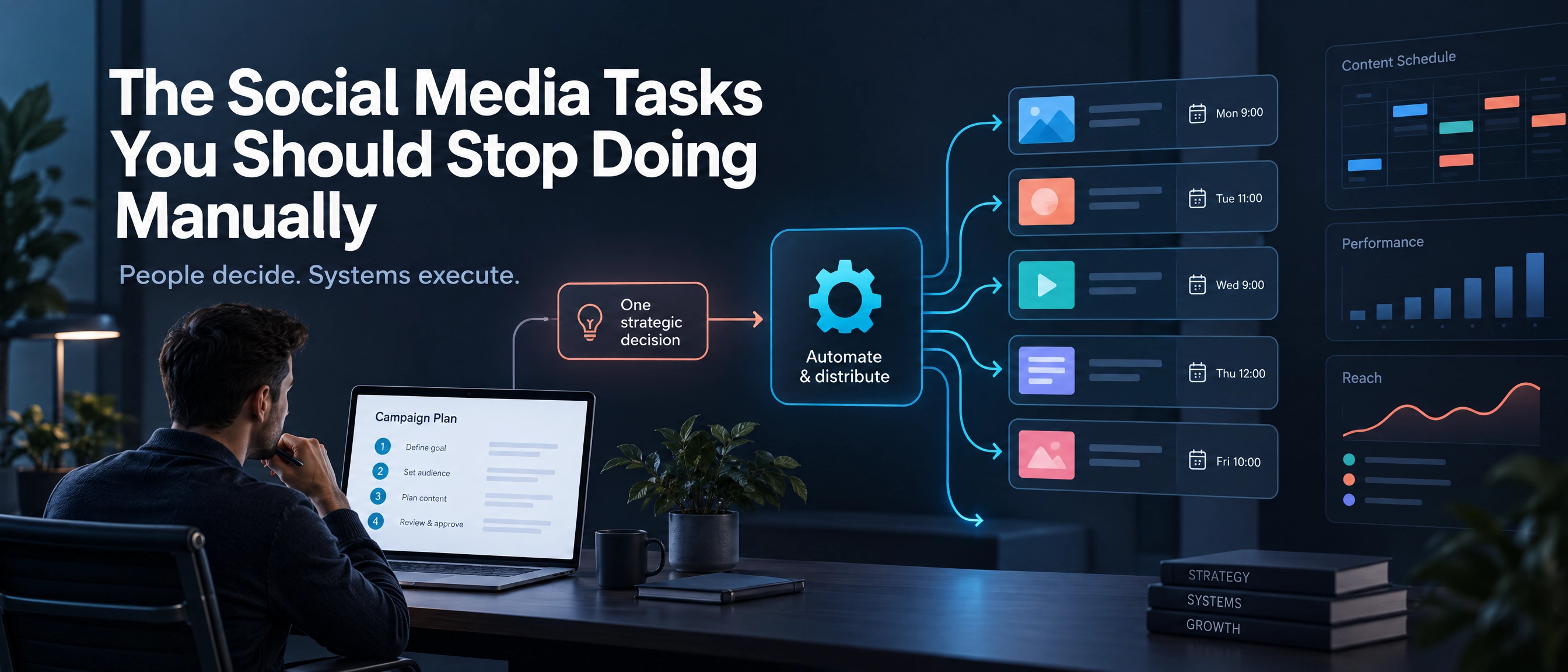
Some social media work needs a marketer.
Some of it needs a button.
The problem is that we often use a person for both.
A marketer decides what to say.
Then spends the next hour uploading it to six accounts.
That isn't marketing.
That's execution.
And execution is exactly where software can help.
The interesting question isn't:
"What can we automate?"
It's:
"What are we still doing by hand that no longer needs human attention?"
That question changes the way you look at social media management.
1. Posting the Same Campaign Again and Again
You create a campaign.
The strategy is done.
The content is ready.
Now comes the repetitive part.
Open Facebook.
Post.
Open Instagram.
Post.
Open X.
Post.
Open LinkedIn.
Post.
Then do it again for another account.
And another.
And another.
At some point, the marketer is no longer making decisions.
They're operating a machine manually.
That is a good place for automation.
The human decides where the campaign should go.
The system handles the repetitive publishing work.
2. Scheduling Posts One by One
If you already know that something should be published tomorrow at 10:00, there is very little strategic value in remembering to do it tomorrow at 9:58.
Schedule it.
Move on.
This sounds obvious.
Yet a huge amount of social media work still depends on someone remembering what needs to happen next.
Good systems don't rely on memory for predictable tasks.
They rely on schedules.
3. Repeating the Same Work Across Multiple Accounts
One account is easy.
Ten accounts are different.
Fifty accounts are a different business entirely.
The work itself hasn't changed.
The number of times you have to repeat it has.
That's where manual management starts to become expensive.
Not because each task is difficult.
Because there are too many of them.
Automation gives you something more important than speed:
scale without multiplying the same manual work.
4. Checking Every Account Yourself
This one is easy to underestimate.
You open an account.
Check it.
Open another.
Check it.
Then another.
Nothing happened.
Then another.
Still nothing.
You are spending attention to discover that there is nothing to pay attention to.
A better system watches routine activity for you.
When something needs attention, you look at it.
That is the difference between monitoring and checking.
5. Finding the Same Types of Content Every Day
Suppose you want to monitor a few keywords.
Or hashtags.
Or topics.
Or news sources.
You can search for them manually every morning.
You can also build a system that watches them continuously.
The second approach doesn't replace judgment.
It removes the boring part before judgment begins.
That's an important distinction.
Automation doesn't have to make the decision.
Sometimes its job is simply to make sure the right information reaches you.
6. Moving Content From One Place to Another
A blog is published.
Now someone needs to turn it into social posts.
A campaign is created.
Now someone needs to distribute it.
An RSS feed produces an article.
Now someone needs to review it.
A piece of content exists.
Then comes the endless copying, adapting, scheduling and publishing.
This is where a social media workflow starts to look less like marketing and more like logistics.
And logistics is highly systematizable.
7. Rebuilding the Same Campaign Structure
Not every campaign is the same.
But many campaigns use the same basic structure.
Accounts.
Content.
Platforms.
Schedules.
Monitoring.
Reporting.
Why rebuild that structure every time?
Templates exist for a reason.
If the process repeats, build the process once.
Then reuse it.
Your creativity should go into the campaign.
Not into recreating the machinery around it.
8. Manually Managing Content Queues
Here's a simple test.
Look at your content queue.
If someone has to sit there and repeatedly decide:
Which account?
Which post?
Which platform?
What time?
Next?
Next?
Next?
You probably don't have a content problem.
You have an execution problem.
The more content you produce, the more obvious this becomes.
A system should be able to handle the routine queue.
People should handle the exceptions.
9. Collecting Numbers Instead of Studying Them
Reporting has the same problem.
Someone opens Facebook.
Copies a number.
Opens Instagram.
Copies another.
Opens X.
Copies another.
Then spends another hour putting everything into a report.
But the valuable question isn't:
"What happened?"
It's:
"What should we do about it?"
Collecting information can increasingly be automated.
Interpreting it is where human attention becomes valuable.
10. Repeating Tasks That Have Already Been Solved
This may be the biggest one.
If you have already figured out how a task should work, why solve it again tomorrow?
And next week?
And next month?
The first time you perform a task, you learn something.
The hundredth time, you are probably just repeating yourself.
That is the moment to ask whether the process belongs in a system.
The Real Problem Isn't Time
People often talk about automation as a way to save time.
That's true.
But it's not the most interesting benefit.
The bigger benefit is attention.
Your attention is limited.
Your software doesn't need coffee.
It doesn't get distracted.
It doesn't forget that something was supposed to be published at 9:00.
And it certainly doesn't need to manually open the same five dashboards every morning.
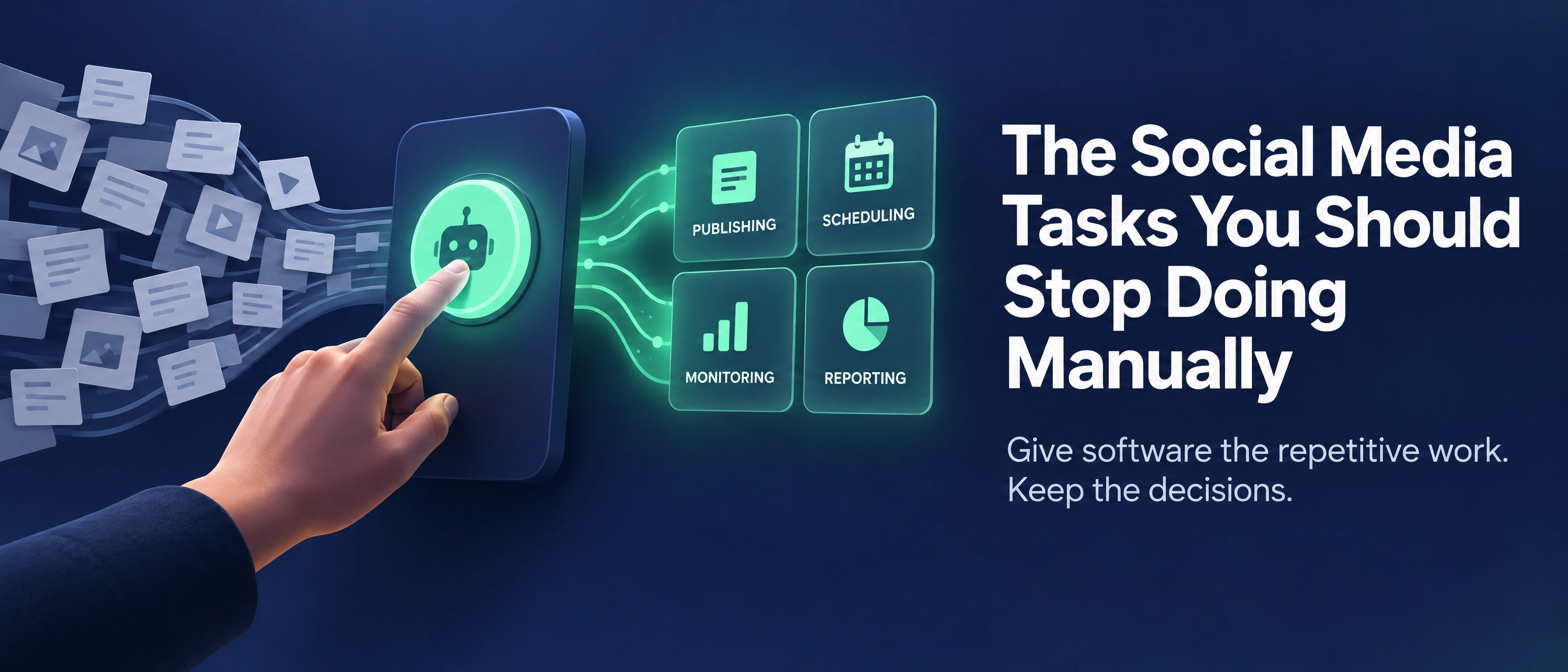
So give software the repetitive work.
Keep the decisions.
What Should Stay Human?
Quite a lot.
Strategy should stay human.
Creative direction should stay human.
Brand decisions should stay human.
Important conversations should stay human.
Judgment should stay human.
The goal isn't to automate everything.
It's to make a better division of labor.
People decide.
Systems execute.
People interpret.
Systems monitor.
People create.
Systems distribute.
That's a much more useful way to think about social media automation.
The Best Automation Is Often Boring
This is the funny thing about good automation.
When it works well, nobody notices it.
The post went out.
The campaign ran.
The content was distributed.
The system monitored the activity.
Nothing dramatic happened.
Good.
That's exactly what should happen.
The best automation isn't necessarily the flashy stuff.
It is the boring work that quietly disappears from your day.
And once enough of that work disappears, something interesting happens.
You get your attention back.
That's the real value.
Not fewer clicks.
Not a prettier dashboard.
More human attention available for work that actually needs a human.
The Simple Test
Before doing a repetitive social media task manually, ask:
Does this happen often?
Does it follow a rule?
Does it happen across multiple accounts?
Does it happen across multiple platforms?
Would the outcome be the same if software handled the execution?
If the answer is yes to most of these questions, you may not have a task.
You may have an automation opportunity.
And that is the shift modern social media teams need to make.
Stop asking people to become faster at repetitive work.
Build systems that make repetitive work disappear.