



When AI Can Write the Tweet but Can't Post It: The New Problem in Social Media Automation
AI has made one part of marketing almost ridiculously cheap.
Ideas are cheap.
Words are cheap.
Images are cheap.
Videos are getting cheaper.
A marketer can now sit down with a blank screen and, within minutes, produce what once required a writer, designer, editor and perhaps an entire afternoon of work.
But there is a strange gap emerging in modern marketing.
Creating something is becoming easy. Getting something done is not.
That distinction may become one of the defining stories of the next generation of AI software.
The Great Illusion of AI Productivity
The internet is filling up with demonstrations of what AI can create.
Write an article.
Generate ten tweets.
Create a product description.
Make an image.
Produce a video.
Rewrite the campaign in five different tones.
The demonstrations are impressive.
But there is an uncomfortable question hiding behind them:
What happens next?
A marketing department doesn't get paid because it generated 50 captions.
It gets paid because those captions reached people.
A company doesn't grow because AI produced a beautiful campaign strategy.
It grows because the strategy was executed.
A brilliant social-media post sitting inside a dashboard is not marketing.
It is inventory.
From Creation to Execution
For decades, software was built primarily around doing what humans told it to do.
Schedule this.
Publish that.
Move this file.
Send this email.
Update this spreadsheet.
Then AI arrived and changed the equation.
Software could suddenly interpret language, summarize information, generate ideas and make decisions.
The machine started becoming capable of thinking.
But thinking introduced a new problem.
Who—or what—actually executes the decision?
This creates an interesting new division:
AI creates intelligence.
Automation creates execution.
The future isn't about choosing one.
It's about connecting them.
The Marketing Department Is Becoming a Machine
Imagine a small marketing team.
Monday morning, someone identifies a topic.
AI researches it.
Another system turns the idea into an article.
A content engine produces supporting images and video.
The marketing team approves the material.
Then automation distributes it across the company's social channels.
The system schedules the campaign.
Performance data comes back.
The next round of content is adjusted.
Suddenly, five people can operate something that resembles a much larger media organization.
That is the real promise of AI automation.
Not simply more AI-generated content.
But more output from the same human judgment.
This Changes the Meaning of “Automation”
For years, social media automation was mostly about saving time.
Instead of manually publishing the same type of post repeatedly, software could schedule and distribute it.
Useful?
Absolutely.
But AI changes the ambition.
Now the question becomes:
How much of the entire marketing loop can software help operate?
From:
Idea → Content → Campaign → Distribution → Monitoring → Improvement
That's considerably more interesting than:
Post → Schedule → Repeat.
The software stops looking like a calendar.
It starts looking like an operating system for marketing.
One Idea Can Become an Entire Campaign
This is where the economics become fascinating.
Suppose a company produces one excellent piece of content.
Historically, that might mean one article.
Perhaps it gets posted on the company website.
Then someone creates a social post about it.
Maybe another person makes a newsletter.
And eventually everyone moves on to the next idea.
But the modern content machine can think differently.
One idea can become:
- a long-form article
- several short social posts
- a video
- short-form video clips
- discussion prompts
- visual content
- platform-specific variations
- follow-up posts
- campaign sequences
The original idea hasn't changed.
The distribution has.
This is one reason content repurposing is becoming such an important marketing strategy.
The scarce resource isn't necessarily content anymore.
It is attention.
And if attention is scarce, distribution becomes strategically important.
The Real Advantage Isn't “AI Writes Faster”
This is where many AI marketing conversations go wrong.
Everyone asks:
Which AI writes the best content?
That is only one piece of the puzzle.
A better question is:
Which system helps a small team turn good ideas into repeated, organized distribution?
Because the difference between producing ten posts and getting ten posts into the world is enormous.
The first is generation.
The second is execution.
And businesses ultimately care about the second.
Why Small Teams May Benefit the Most
Large companies can afford specialists.
A writer.
A social-media manager.
A designer.
A video editor.
A campaign manager.
An analyst.
An agency.
Small businesses usually cannot.
So AI and automation create an unusual economic possibility.
Instead of replacing one employee with software, a small team can effectively multiply its capacity.
Three marketers can behave more like ten.
Ten marketers can behave more like thirty.
Not because they suddenly became more talented.
Because the repetitive machinery surrounding their judgment became dramatically more efficient.
That's a very different way to think about AI.
JarveePro and the Execution Layer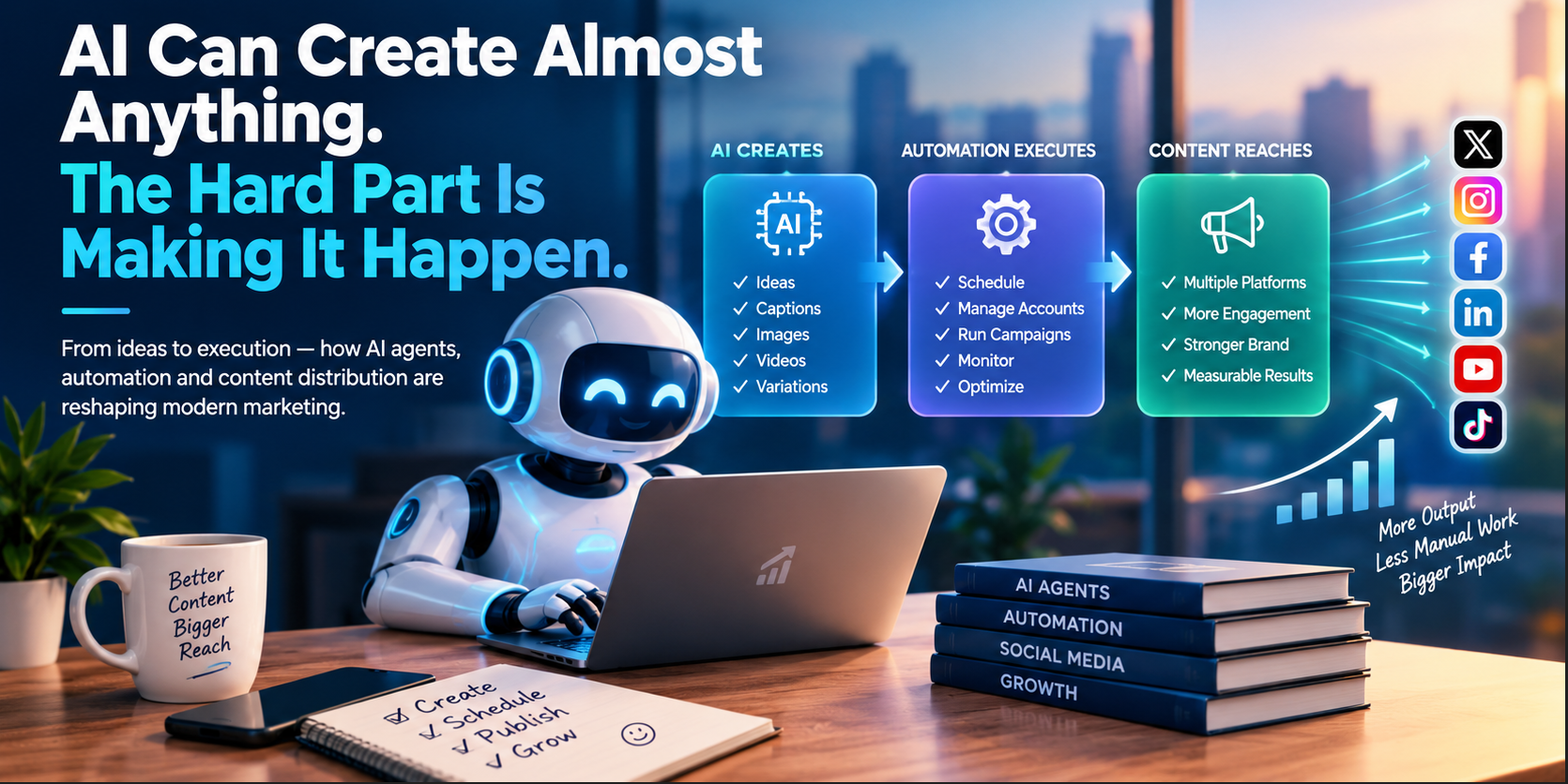
This is where JarveePro fits into the larger picture.
The interesting problem isn't simply generating another social-media caption.
There are already countless tools capable of doing that.
The bigger challenge is managing the distribution machinery around social media.
Multiple accounts.
Multiple platforms.
Multiple campaigns.
Scheduling.
Publishing.
Content distribution.
Monitoring.
Repetition.
Organization.
That's where automation becomes valuable.
JarveePro brings those operational pieces together, while its newer AI direction points toward a broader idea:
social media software that doesn't merely help create content, but helps turn content into action.
And that's a much more interesting category.
The Next Battle in AI Won't Be Who Can Write the Best Paragraph
For a while, every AI company competed on writing quality.
Who produces the most natural paragraph?
Who writes the best headline?
Who creates the most convincing image?
Who generates the best video?
That competition will continue.
But eventually, the question changes.
Imagine two systems.
System A generates brilliant content but leaves the marketer to figure out what happens next.
System B generates good content and helps turn it into an organized, measurable distribution process.
Which one creates more business value?
The answer is probably not the one with the prettier demo.
AI Agents Make This Even More Interesting
The rise of AI agents pushes the idea one step further.
A chatbot waits for instructions.
An agent can potentially work through a sequence of tasks.
That changes the architecture of software.
Instead of:
Human → Software → Result
we start moving toward:
Human → Goal → AI → Tools → Actions → Result
The software becomes less like a calculator and more like an employee.
But there is an important distinction.
An employee doesn't just generate ideas.
An employee gets things done.
That's why the future of AI agents will depend heavily on reliable tools, integrations and execution systems.
Intelligence without execution is a consultant.
Intelligence with execution starts becoming an operator.
The Marketing Machine of the Future
Perhaps the most interesting possibility is that the future marketing department won't necessarily become much larger.
It may become smaller.
A handful of people could handle:
Research
→ Strategy
→ Creation
→ Approval
→ Distribution
→ Measurement
with software doing much of the repetitive work around them.
The human remains responsible for judgment.
The machine handles scale.
That combination could be extraordinarily powerful.
The New Marketing Equation
The old equation was roughly:
More people → More content → More distribution
The emerging equation looks more like:
Better judgment × Better AI × Better automation = More output
That multiplication sign matters.
Because if AI can reduce the cost of creation and automation can reduce the cost of distribution, a small team suddenly has access to something that previously belonged mostly to large organizations:
scale.
And scale changes strategy.
The Most Valuable AI May Be the AI You Don't Notice
There's another twist here.
The most impressive AI may not be the one producing the most spectacular demo.
It may be the AI working quietly behind the scenes.
Finding topics.
Preparing content.
Creating variations.
Organizing campaigns.
Connecting workflows.
Watching results.
Helping people make decisions.
Then letting automation carry those decisions into the real world.
That's less glamorous than generating a photorealistic dragon riding a motorcycle.
But for a business?
Probably more useful.
The Real AI Revolution Is From “Can You Create It?” to “Can You Execute It?”
That may be the question worth watching.
AI has already made creation dramatically easier.
Now the industry is moving toward a harder problem:
How do we connect intelligence to execution?
Because the value of an idea isn't determined only by how clever it is.
It is determined by what happens to it.
An idea that stays inside a prompt is potential.
An idea that becomes content is production.
An idea that becomes a campaign is marketing.
An idea that reaches thousands of people, generates conversations and produces measurable results is execution.
And that is where AI-powered automation gets really interesting.
The next generation of marketing software won't simply help businesses create more.
It will help them do more with what they create.
That is a much bigger opportunity.