



You’re Not Using Automation — You’re Using Agents Now
Introduction
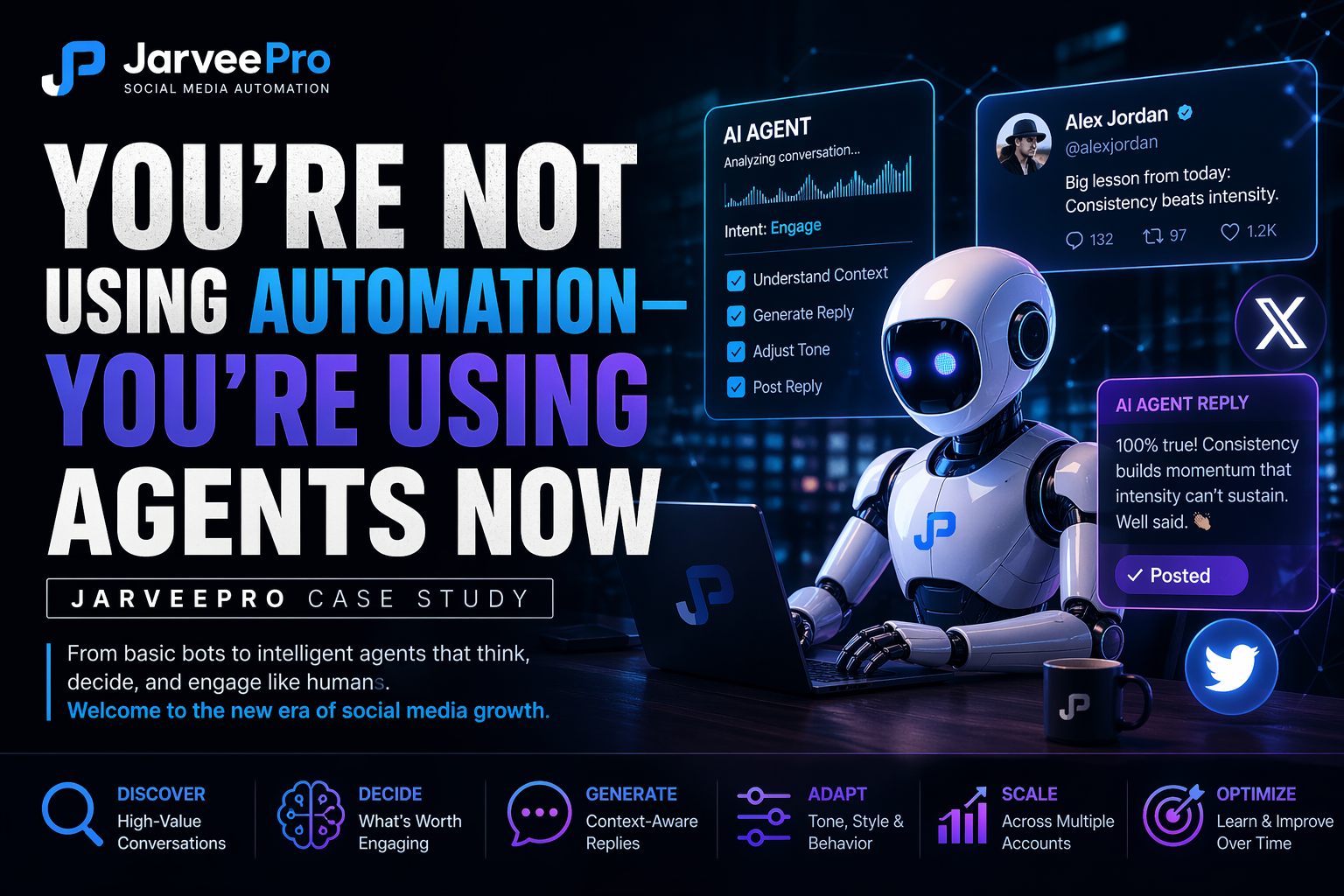
There’s a quiet shift happening in social media marketing, and most people are still describing it with the wrong vocabulary.
They keep saying “automation tools.”
But what’s actually running the show now looks very different.
We’re not talking about scheduled posts and basic bots anymore.
We’re talking about systems that observe, decide, and respond.
In other words: agents.
This case from JarveePro shows exactly how that mindset shift is playing out in real workflows — and why users who still think in “tools” are already one step behind.
The Case: “Can You Build Me a Reply Extension Inside JarveePro?”
A user came in with a simple idea:
He wanted something like a Chrome extension that could:
- Reply automatically to big accounts
- Randomize responses
- Adjust tone and writing style
- Run across multiple accounts
- Feel “smart,” not scripted
On the surface, that sounds like a tool request.
But underneath it, he wasn’t asking for a tool at all.
He was asking for behavior.
He wanted something that acts, not just executes.
That’s where the conversation shifted.
Because JarveePro isn’t just a scheduler anymore.
It’s closer to an orchestration layer for AI-driven agents.
The Real Shift: From Automation to Agentic Systems
Traditional automation works like this:
If X happens → do Y
Agentic systems work like this:
If X happens → analyze context → decide Y → adjust tone → execute → learn from outcome
That difference sounds subtle.
It’s not.
It changes everything.
Old Automation Thinking:
- Post content
- Reply with preset templates
- Follow/like based on rules
- Repeat actions
Agentic Thinking:
- Identify relevant conversations
- Decide whether engagement is worth it
- Generate context-aware replies
- Adjust tone based on target audience
- Optimize engagement patterns over time
One is mechanical.
The other is behavioral.
And social platforms reward behavior, not mechanics.
Where JarveePro Fits Into This Shift
Inside JarveePro workflows, this transition becomes very obvious once you look at how users actually build campaigns.
Instead of thinking:
“I need a reply tool”
Advanced users think:
“I need a reply agent that represents my voice in conversations I never manually read”
That’s a completely different design philosophy.
With JarveePro-style setups, users can combine:
- Content discovery (what to engage with)
- AI-driven reply generation (how to respond)
- Tone control (how it sounds)
- Account scaling (where it runs)
- Behavioral randomness (how natural it feels)
This is no longer “posting automation.”
It’s distributed decision-making.
What the User Actually Wanted (Without Realizing It)
Let’s break it down honestly.
The user thought he needed:
- A Chrome extension clone
- AI replies for tweets
- Random engagement behavior
But what he really wanted was:
A system that can:
- Watch high-value conversations
- Decide when to join
- Speak in a consistent brand voice
- Scale across accounts
- Avoid looking robotic
That’s not a plugin.
That’s an agent network.
And once you see it that way, the solution space changes completely.
Why “Reply Bots” Are Dead (Even If They Still Work)
Here’s the uncomfortable truth:
Basic reply bots still exist — but they’re already socially outdated.
Why?
Because platforms have evolved faster than them.
Users can instantly detect:
- Repetition
- Template language
- Low-context replies
- Mechanical timing patterns
And when users detect it, engagement drops fast.
Agentic systems solve this by introducing variability with intent.
Not randomness.
Intent.
That’s the key difference.
The New Layer: Content + Context + Decision
Modern engagement systems are built on three layers:
1. Content Layer
What is being said
(Generated text, replies, posts)
2. Context Layer
Why it’s being said
(Thread relevance, audience type, timing)
3. Decision Layer
Whether it should be said at all
(Filtering, scoring, prioritization)
Most “automation tools” only handle layer 1.
Agentic systems operate across all three.
That’s why they feel alive instead of scripted.
What Makes JarveePro-Style Agentic Workflows Powerful
When users connect AI models into campaign logic, something interesting happens:
The system stops behaving like a tool.
It starts behaving like a worker.
Key capabilities include:
- Dynamic reply generation based on post content
- Tone adjustment depending on target account size
- Engagement filtering (not every post deserves attention)
- Multi-account orchestration
- Continuous variation in output style
And most importantly:
It removes the need for constant human micromanagement.
That’s the real shift.
Not speed.
Autonomy.
The Common Mistake Users Make
Most users still approach this like:
“How do I automate this task?”
But agentic systems require a different question:
“What decision should the system be making on my behalf?”
That one change flips everything.
Because now you’re not building workflows.
You’re designing behavior.
And behavior scales far better than tasks.
Why This Matters in 2026
Social platforms are getting noisier, not simpler.
That creates a bottleneck:
- Humans can’t scale attention
- Static bots get ignored
- Manual engagement doesn’t scale economically
So the only viable middle ground is:
AI agents that behave like semi-independent operators
Not fully autonomous chaos.
Not rigid automation.
Something in between.
That’s where tools like JarveePro are being pushed — whether people realize it or not.
The Future: From Campaigns to Agent Networks
Here’s where things are heading:
Instead of:
- “Run a campaign”
We’ll see:
- “Deploy engagement agents”
Instead of:
- “Schedule posts”
We’ll see:
- “Assign content roles to AI personas”
Instead of:
- “Reply to comments”
We’ll see:
- “Maintain conversational presence in selected ecosystems”
This is not a UI upgrade.
It’s a conceptual rewrite of how marketing systems work.
Summary
The user thought he needed a clone of a Chrome extension for AI replies.
What he actually needed was something bigger:
A system that behaves intelligently inside conversations.
That’s the core idea behind agentic automation.
And JarveePro sits right in the middle of that transition — where tools stop being tools and start becoming decision-making layers.
The real takeaway is simple:
If your system is only executing tasks, it’s already outdated.
If it’s making decisions inside constraints, you’re in the agent era.
And that gap between the two?
That’s where the next generation of social media advantage lives.