



The Customer Can't Ask for What They Can't Imagine
The most valuable product opportunities may begin with a customer request that sounds completely different from the product you eventually build.
A customer comes to you and says:
“I need 100,000 comments on X and TikTok.”
At first glance, this sounds like a very specific request.
Perhaps they need a service. Perhaps they need more accounts. Perhaps they need a tool for posting comments at scale.
But there may be another question hiding underneath:
Why does this customer need 100,000 comments in the first place?
And what if the customer knows the outcome they have been asked to produce, but has no idea what kind of technology could produce it?
This is where product development becomes much more interesting.
Customers usually describe the problem in the language they already know
Most customers cannot describe technologies that do not yet exist in their mental model.
A person who has always managed social media manually might ask for:
more accounts
more people
faster posting
more comments
more likes
more content
a better scheduler
They are describing the problem using the tools and methods they already understand.
That does not mean they are wrong.
In fact, they may understand the business problem extremely well.
The limitation is different:
They may not know what is technically possible.
This distinction matters enormously.
Harvard Business School's Jobs-to-Be-Done framework describes customers as essentially “hiring” products to accomplish a job. The important question is therefore not simply What product does the customer want? but What progress are they trying to make?
That changes how a company should listen.
Instead of asking:
“What feature did the customer request?”
ask:
“What situation caused the customer to request it?”
The 100,000-comment customer
Consider a hypothetical social-media agency.
Its client is a major public figure.
The client says:
“We need 100,000 comments across X and TikTok.”
The agency now has a problem.
It may start looking for:
account providers
workers
automation tools
proxies
comment services
scheduling software
The agency isn't necessarily looking for an “AI social-media operating system.”
It may not even know such a concept exists.
Its immediate requirement is simply:
Deliver the number.
But once you examine the workflow, a much larger problem appears.
The agency may need to coordinate:
Accounts → identities → content → comments → timing → targeting → multiple platforms → monitoring → reporting
Suddenly, “100,000 comments” looks less like a standalone feature request.
It looks like a symptom of a much larger operational problem.
And this is where product intelligence begins.
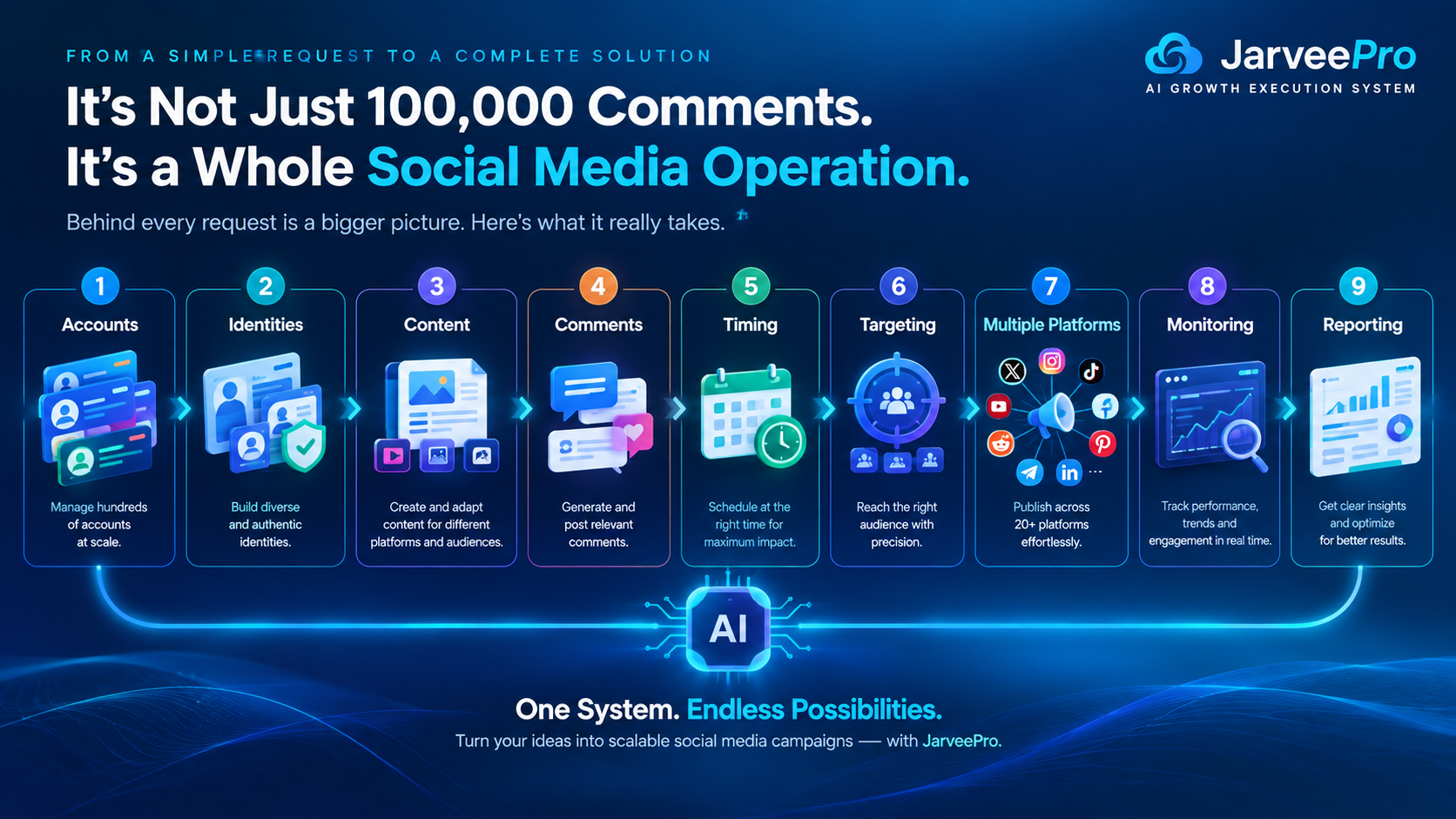
The gap between expressed demand and latent demand
There are two kinds of demand worth paying attention to.
Expressed demand
This is what customers directly ask for.
“I need 100,000 comments.”
“I need 500 accounts.”
“I need to post to ten platforms.”
“I need someone to manage this for me.”
This demand is easy to see because customers articulate it.
Latent demand
This is the capability that could become valuable once the customer understands that it is possible.
The customer might eventually realize:
“Wait. I don't actually want to manage 500 accounts manually.”
Or:
“I don't want to keep ordering individual campaigns.”
Or:
“Why am I creating the same content separately for every platform?”
Or:
“Could an AI system coordinate all of this for me?”
That is a different kind of opportunity.
The customer did not necessarily arrive asking for it.
The product has to make the possibility visible.
Research on unmet needs makes a similar point: even organizations that are good at scanning markets can struggle to perceive and correctly interpret needs that customers have not clearly articulated.
The dangerous interpretation: “Customers don't know what they want”
This idea can easily become bad product strategy.
It is tempting for a company to say:
“Customers don't know what they want. We know better.”
That attitude is dangerous.
Customers know things the product team doesn't.
They know:
what hurts
what costs money
what their clients demand
what their employees hate doing
what deadlines they face
what results they are responsible for
The customer has situational knowledge.
The technology company may have capability knowledge.
The opportunity exists where those two meet.
So the better principle is:
Listen to customers for the problem. Use your own expertise to discover the possible solution.
That is very different from ignoring customers.
Don't build what customers ask for. Understand why they asked.
This may be one of the most useful disciplines in product development.
Suppose ten customers request ten different things.
At the feature level, you might see:
| Customer request | Surface requirement |
|---|---|
| “I need 100k comments.” | Comments |
| “I need 300 accounts.” | Accounts |
| “I need to post everywhere.” | Publishing |
| “I need different content for every platform.” | Content creation |
| “I need to know what's trending.” | Monitoring |
You could build five separate features.
Or you could notice the pattern:
These customers are struggling to operate social media at a scale that humans alone cannot comfortably manage.
Now you have a product hypothesis.
The features are symptoms.
The operational problem is the opportunity.
This is where AI changes the product conversation
Traditional software often begins with:
“Which task should we automate?”
AI allows us to ask a larger question:
“Which workflow can we delegate?”
That is a significant shift.
A scheduler automates scheduling.
A content tool automates content creation.
An analytics platform automates reporting.
But an AI agent can potentially coordinate multiple steps toward an outcome.
That means the product category itself can change.
Instead of:
Social Media Scheduler
you can begin thinking about:
Social Media Operations
Instead of:
Account Management
you can think about:
A Digital Workforce
Instead of:
Content Automation
you can think about:
Campaign Execution
The customer may initially ask for a single task.
The product opportunity may be the entire workflow surrounding that task.
The marketing problem: How do you sell something people aren't searching for?
This is the hardest part.
If someone is searching for:
“100k TikTok comments”
you can compete for that search.
But what if the person doesn't know that a coordinated social-media automation system exists?
They won't search for it.
They cannot search for a category they don't yet understand.
This means traditional SEO has a ceiling.
SEO is excellent at capturing existing intent.
But innovative products also need to create intent.
That requires a different kind of marketing.
Don't only answer questions. Create new questions.
Imagine two advertisements.
Advertisement A
JarveePro supports multiple social-media platforms and account automation.
Accurate.
But it requires the reader to understand why that matters.
Advertisement B
What would you do if one person could coordinate hundreds of social-media workflows?
Now the reader has a question.
They may think:
“Could that actually work?”
That curiosity is valuable.
Another example:
You don't need another social-media scheduler. You may need a social-media workforce.
Or:
Your campaign has one piece of content. Why should your distribution process have twenty?
Or:
What if your social-media operation could work while you worked on the strategy?
These messages aren't selling a feature.
They are expanding the customer's mental model.
The most powerful demonstration is often “before and after imagination”
A product nobody understands is difficult to sell with a feature list.
Show the old world:
One person
→ creates content
→ logs into account
→ posts
→ switches platform
→ creates another version
→ checks comments
→ repeats
→ repeats
→ repeats
Now show the possible new world:
One campaign
↓
AI understands the campaign
↓
content variations
↓
multiple platforms
↓
multiple accounts
↓
scheduled workflows
↓
monitoring
↓
human oversight
↓
reporting
The point isn't merely that there are more buttons.
The point is:
The unit of work has changed.
From:
“I need to make a post.”
To:
“I need to operate a campaign.”
That is a much bigger product idea.
Your customers are already telling you where to look
Every unusual customer request can be treated as a piece of market intelligence.
Don't simply record:
Customer wants feature X.
Record:
What situation made feature X necessary?
Then ask:
What were they trying to accomplish?
Who gave them that requirement?
What are they doing manually today?
What part is expensive?
What part is repetitive?
What part requires coordination?
What happens when the scale increases 10×?
What would they ask for if they understood today's technology better?
That last question is particularly interesting.
Because sometimes the best product idea is hiding one level above the customer's request.
The real competitive advantage may be imagination
Software capabilities are increasingly becoming easier to copy.
A competitor can copy a button.
They can copy a workflow.
They can add an AI assistant.
They can reproduce a feature list.
But there is another capability that is much harder to copy:
seeing the customer's future workflow before the customer sees it.
That requires spending time with real customers.
Not simply asking them:
“What features do you want?”
But observing:
“What are you trying desperately to accomplish?”
Then building backward from that reality.
From customer request to new market
The path can look like this:
Customer request
“I need 100,000 comments.”
↓
Underlying job
“I need to create large-scale social activity for a campaign.”
↓
Operational problem
“Coordinating the accounts, content, timing and platforms is difficult.”
↓
Technology opportunity
“Can software coordinate the workflow?”
↓
Product concept
“An AI-powered social-media operating system.”
↓
New customer question
“What else could I accomplish if I had digital employees?”
That final question is where a product begins to create a market rather than merely compete inside one.
The customer doesn't have to imagine the product.
You do.
And then your job as a marketer is to make the customer imagine the outcome.
That's the subtle difference between selling software and creating a category.
The customer doesn't need to walk into your website already knowing what an AI social-media agent is.
They need to recognize themselves in a problem.
Then they need to see a possibility they had not considered.
And finally, they need to think:
“I didn't know I could do that.”
That may be one of the strongest signals a technology company can receive.
Not:
“That's exactly the feature I was searching for.”
But:
“Wait. You mean we can do this?”
That is often where the next market begins.