



The Internet Runs on Belief
A dollar bill is a strange thing.
It is a piece of paper. It cannot feed you, shelter you or drive you anywhere. Yet you can exchange it for all three.
Why?
Because millions of people believe it has value.
That belief is so widespread, so deeply embedded in modern life, that we rarely notice it anymore. A shopkeeper accepts the dollar because she knows someone else will accept it from her. Her supplier accepts it for the same reason. The bank accepts it. The government accepts it.
The dollar works because the belief travels.
Social media works in much the same way.
A follower is not valuable because of the number printed underneath a profile picture. A million followers are valuable because other people believe that the person behind the account is worth listening to.
A brand becomes powerful when people believe it is powerful.
A creator becomes influential when people believe the creator is worth watching.
A product becomes desirable when enough people believe other people want it.
Even a trend is little more than a belief spreading at extraordinary speed.
The internet is, among other things, a machine for manufacturing and distributing belief.
That is why attention has become an economic asset.
From money to attention
For most of human history, scarcity was physical.
Land was scarce.
Oil was scarce.
Factories were scarce.
Distribution was expensive.
The internet changed the equation.
Now the scarce resource is often something much less tangible:
attention.
There may be billions of people online, but every person has only so many hours in a day. Every video competes with another video. Every brand competes with another brand. Every idea competes with another idea.
The result is an unusual market.
The supply of information is almost infinite.
The supply of human attention is not.
That imbalance is why a person with an audience can sometimes be more commercially valuable than a person with a warehouse.
And it explains why companies spend so much time trying to build audiences rather than simply buying advertisements.
An advertisement rents attention.
An audience owns a relationship with attention.
The strange mathematics of influence
Imagine two businesses.
One has a superb product but nobody knows it exists.
The other has an average product and an audience of 500,000 people who pay attention whenever it speaks.
Which business has more power?
The answer is uncomfortable because power does not always follow quality.
It often follows distribution.
A brilliant idea trapped in a drawer is worth very little.
A mediocre idea repeated by millions can become a cultural phenomenon.
Markets eventually respond to that attention.
Advertisers follow audiences.
Investors follow growth.
Consumers follow popularity.
And popularity itself attracts more popularity.
This creates a feedback loop:
attention → visibility → belief → participation → more attention.
The loop can turn a tiny signal into a very large one.
That is one reason social media can feel irrational.
It is not necessarily rewarding the objectively best thing.
It is rewarding the thing that successfully enters the collective consciousness.
This is where automation becomes interesting
For years, social media automation was described as a way to save time.
That description is technically correct and strategically incomplete.
Saving ten minutes is useful.
Building a repeatable distribution system is something else entirely.
If one person can publish to one account manually, that person has a job.
If a system can help organise publishing across dozens of legitimate accounts and platforms, that person has built infrastructure.
The difference is scale.
The same principle exists everywhere in business.
A factory does not make one product.
A logistics network does not deliver one package.
A payment network does not process one transaction.
Systems create leverage by making repetition cheap.
Social media is no different.
But scale creates a new problem
There is a catch.
Once distribution becomes cheap, everyone starts distributing.
The internet therefore produces an extraordinary paradox:
It has made publishing almost free while making being noticed increasingly expensive.
A thousand accounts can publish.
A million accounts can publish.
Billions of pieces of content can be published.
But the human brain still has only 24 hours.
So simply producing more content is not necessarily a strategy.
The question becomes:
What deserves attention?
That is where content quality, positioning, timing, audience understanding and consistency become more important—not less.
Automation can multiply distribution.
It cannot manufacture genuine interest out of nothing.
The machine should multiply judgment, not replace it
This is the mistake made by many automation projects.
They begin with the question:
“Which decisions should humans make, and which repetitive decisions can machines execute?”
That distinction separates useful automation from digital noise.
Humans should decide what the brand stands for.
What audience matters.
What story deserves to be told.
What products deserve attention.
What should never be posted.
Software can then help with the repetitive machinery surrounding those decisions: scheduling, organisation, publishing workflows, monitoring and account management.
This is where a platform such as JarveePro becomes interesting.
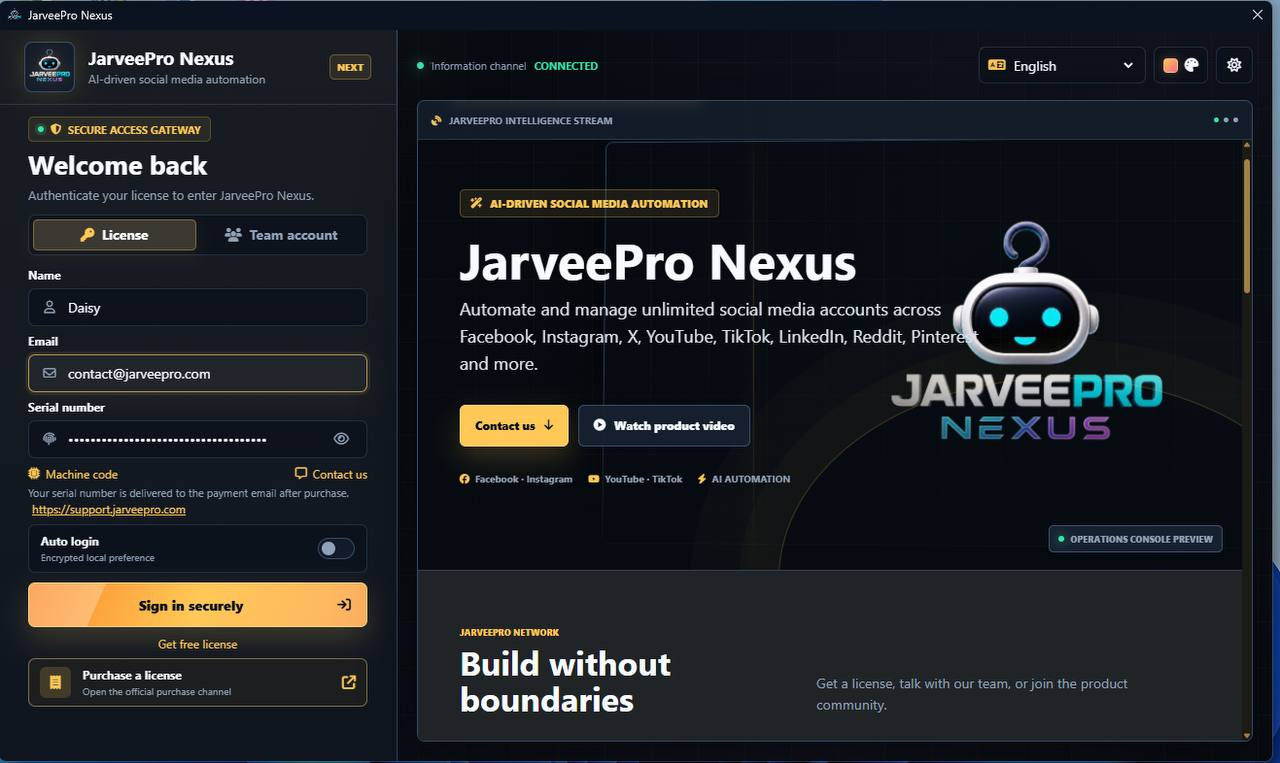
Its value is not that it magically creates influence.
Nothing does.
Its value is that it can provide an operational layer for managing repetitive social-media activity across multiple accounts and platforms, allowing the human operator to spend less time performing mechanical tasks and more time thinking about the strategy behind them.
The software is the machinery. The strategy is the mind.
Confusing the two is expensive.
The future belongs to systems
The next generation of social-media operations will probably not be defined by who can post the most.
There is simply too much content already.
They will be defined by who can build the best systems for turning ideas into attention, attention into trust, and trust into something valuable.
That may be a sale.
It may be a community.
It may be a brand.
It may be influence.
Or it may simply be the ability to make an idea travel farther than it otherwise would.
And perhaps that brings us back to the dollar.
A dollar works because belief travels from one person to another.
Social media works for much the same reason.
An idea has value when people believe it is worth their attention.
The internet's great business opportunity, therefore, isn't merely to produce more content.
It is to understand how belief moves.
And once you understand that, social media starts to look less like a collection of apps—and more like the world's largest marketplace for attention.