



How Traditional Businesses Are Using Social Media Automation to Stay Competitive
Social Media Isn't Just for Influencers Anymore
When people hear "social media automation," they often imagine influencers, affiliate marketers, or agencies managing hundreds of client accounts.
But one of the most interesting conversations we've had recently challenged that assumption.
A prospective JarveePro customer reached out with several technical questions before making a purchase. During our conversation, they casually mentioned they run a traditional import business.
That immediately reminded us of an important truth:
Social media has become a business tool for every industry—not just digital-first companies.
Whether you're importing products, manufacturing goods, supplying construction materials, distributing industrial equipment, or running a wholesale operation, your customers are already spending time on social platforms.
The question isn't whether your business belongs on social media.
The question is whether you're using it efficiently.
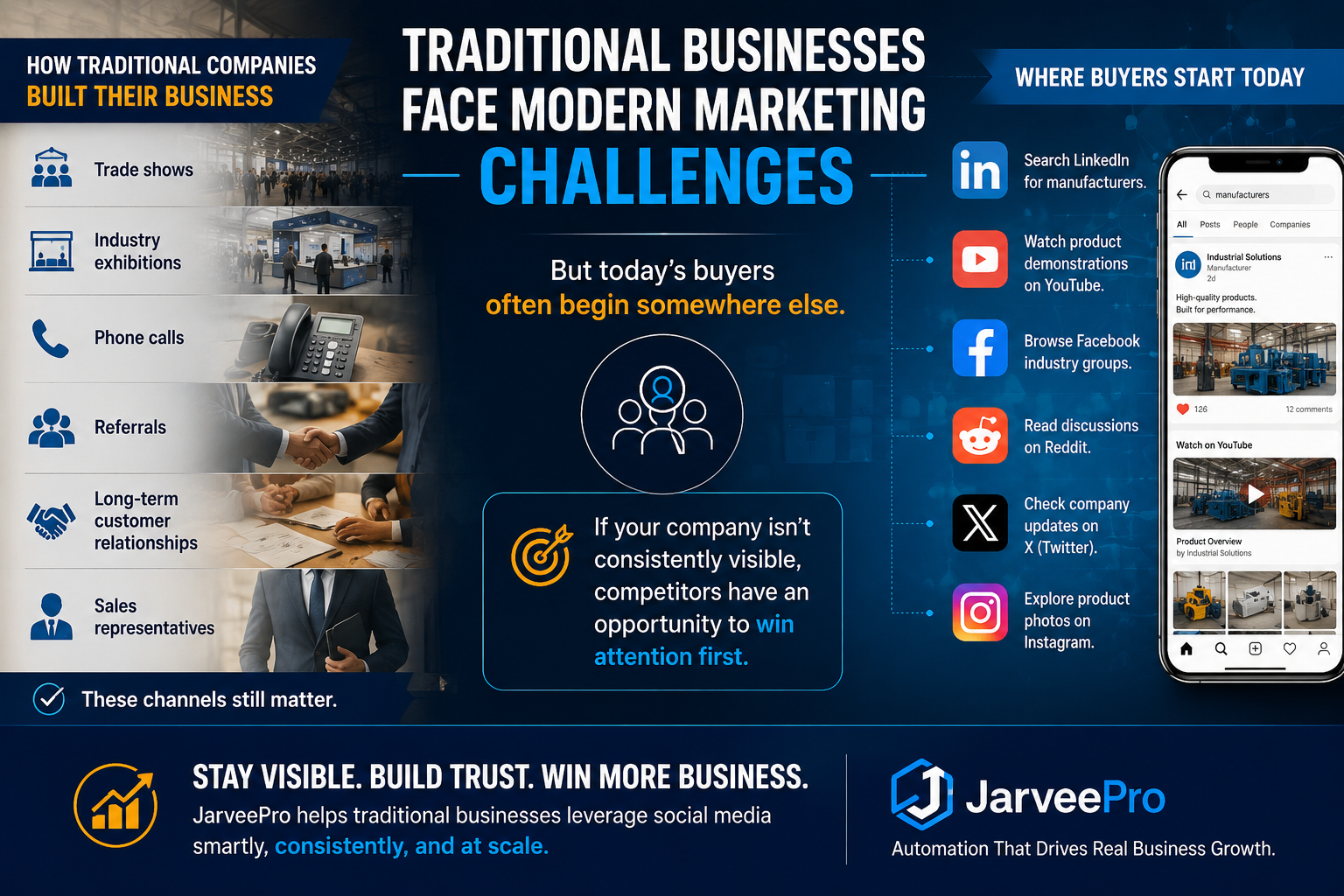
Traditional Businesses Face Modern Marketing Challenges
Many traditional companies built their businesses through:
Trade shows
Industry exhibitions
Phone calls
Referrals
Long-term customer relationships
Sales representatives
These channels still matter.
But today's buyers often begin somewhere else.
Before contacting a supplier, they may:
Search LinkedIn for manufacturers.
Watch product demonstrations on YouTube.
Browse Facebook industry groups.
Read discussions on Reddit.
Check company updates on X (Twitter).
Explore product photos on Instagram.
If your company isn't consistently visible, competitors have an opportunity to win attention first.
Consistency Is Difficult Without Automation
For many manufacturers and distributors, marketing isn't the primary focus.
Operations, purchasing, logistics, inventory, production, and customer service naturally take priority.
That often leads to social media being updated only occasionally.
A company might publish several posts during a product launch and then disappear for weeks.
Potential customers notice that.
Consistency builds credibility.
Automation helps maintain that consistency without requiring someone to post manually every day.
Social Media Is About More Than Publishing
One misconception is that automation simply schedules posts.
Modern social media automation goes much further.
Businesses can organize workflows that help them:
Share new products across multiple platforms.
Schedule educational content.
Monitor industry keywords.
Engage with relevant discussions.
Follow potential business partners.
Reply to comments more efficiently.
Promote blog articles.
Build brand awareness over time.
Instead of treating social media as an occasional task, it becomes an ongoing business process.
Where Traditional Businesses Can Benefit
Companies in many industries are using social media to strengthen their marketing, including:
Manufacturing
Import and export
Wholesale distribution
Construction materials
Furniture suppliers
Industrial equipment
Packaging
Logistics
Agricultural products
Building materials
Electronics distribution
Automotive parts
Commercial services
Regardless of the industry, the objective is often the same:
Stay visible, build trust, and create opportunities for future business.
Automation Supports Your Sales Team
Social media should not replace your sales department.
It should make your sales team more effective.
Imagine a prospect who has already:
Seen your product updates.
Read your educational content.
Recognized your company name.
Followed your page for several months.
When your salesperson finally contacts them, the conversation starts with familiarity instead of a cold introduction.
That's one of the biggest advantages of maintaining an active online presence.
Growing Without Hiring a Large Marketing Team
Many traditional businesses don't want to hire several full-time employees just to keep multiple social channels active.
Automation helps smaller teams accomplish more by:
Planning content in advance.
Managing multiple platforms from one dashboard.
Organizing campaigns.
Reducing repetitive tasks.
Maintaining a regular publishing schedule.
Instead of replacing people, automation allows existing teams to focus on strategy, customer relationships, and business growth.
JarveePro Helps Scale the Process
JarveePro is designed for businesses that need more than a simple scheduling tool.
It supports marketing teams by helping them:
Manage multiple social media accounts.
Schedule and distribute content.
Organize engagement campaigns.
Monitor conversations.
Coordinate activities across different platforms.
Scale operations as the business grows.
Whether you're a manufacturer expanding into new markets or a distributor building relationships with dealers, automation can help keep your marketing organized and consistent.
The Future Belongs to Businesses That Adapt
The companies succeeding today are not always the ones posting the most content.
They're the ones that communicate consistently, respond quickly, and remain visible where customers spend their time.
That includes businesses that have existed for decades.
Manufacturing, wholesale, logistics, construction, import/export, and industrial companies are discovering that social media is no longer optional—it's another channel for building trust and generating opportunities.
The tools may be modern, but the goal remains the same:
Build relationships.
Earn trust.
Grow the business.
Conclusion
Our recent conversation with a customer in a traditional industry reinforced something we've seen repeatedly over the years: social media automation isn't reserved for influencers or digital marketing agencies.
Businesses across every sector are embracing automation to simplify repetitive work, strengthen customer relationships, and maintain a professional online presence.
If your business has customers, partners, suppliers, or prospects using social media, there's an opportunity to meet them there—efficiently, consistently, and at scale.
The businesses that adapt today will be better positioned to compete tomorrow.