



How to Publish Videos Across Multiple Social Media Accounts at Scale
Creating a good video takes time.
Publishing that video once takes minutes.
Getting that same piece of content in front of audiences across dozens, hundreds, or even thousands of social media accounts is where things get interesting.
For marketers, agencies, creators, affiliate businesses, and brands managing multiple social profiles, the challenge is no longer simply how to create more videos.
It is: How can you get more reach and more value from every video you create?
This is where large-scale video publishing becomes a powerful part of a modern social media marketing strategy.
Instead of treating every social account as a separate publishing project, marketers can think of video as a reusable marketing asset that can be distributed across multiple audiences.
The Real Value of One Video
A successful video can represent hours of research, scripting, recording, editing, branding, and optimization.
It makes little business sense to think of that video as something that only belongs to one social media account.
A single piece of content can potentially support an entire distribution strategy.
For example, a product video could be used across multiple brand accounts.
An educational video could reach audiences in different communities.
A promotional video could support several regional accounts.
A creator could distribute the same core video through different profiles targeting different niches.
The video itself may remain the same while the audience, account, timing, and context change.
That is the fundamental idea behind scalable video marketing:
Create valuable content once. Find more opportunities to distribute it.
Why Video Distribution Is Becoming More Important
Social media has moved heavily toward video.
Short-form videos, reels, clips, tutorials, product demonstrations, interviews, explainers, reviews, and educational content can all become recurring sources of attention.
But creating content is only half of the equation.
The other half is distribution.
A marketer can spend an entire day creating one excellent video and still reach only a fraction of its potential audience if that video is published in only one place.
This creates a growing gap between content production and content distribution.
Businesses that solve the distribution side can often get considerably more mileage from the content they already produce.
One Video Can Serve Multiple Audiences
One of the biggest misconceptions about multi-account marketing is that every account needs completely different content.
That is not always the case.
A business might have several accounts serving different audiences but sharing the same underlying brand message.
For example, imagine a company promoting a new product.
The company could have:
A primary brand account
Regional accounts
Product-specific accounts
Community accounts
Customer-focused accounts
Industry-specific accounts
The same core video could be relevant to all of them.
Rather than creating an entirely new video for every account, the marketing team can use the existing content as a distribution asset.
This doesn't mean every account needs to publish identical content all the time.
It means marketers can identify content that is broadly useful and distribute it more efficiently.
From Content Creation to Content Distribution
Traditional social media marketing often follows a simple pattern:
Create → Publish → Move on
A more scalable approach looks at the entire lifecycle of the content.
A video is created.
It generates engagement.
It is reused in another campaign.
It reaches another audience.
It becomes part of a content library.
It may later support a product launch, educational campaign, promotion, or seasonal strategy.
The value of the video therefore doesn't end with its first publication.
The question becomes:
How many useful opportunities can this piece of content create?
That is a much more powerful way to think about video marketing.
What Happens When You Manage 10, 50, or 500 Accounts?
The strategy changes as the number of accounts grows.
With three accounts, manually publishing a video isn't a big deal.
With 20 accounts, repetitive publishing starts consuming meaningful time.
With 100 accounts, content distribution becomes a process that needs structure.
With hundreds of accounts, manually repeating the same actions can become one of the largest operational bottlenecks in the marketing workflow.
This is why scale changes the economics of social media marketing.
The problem isn't necessarily that marketers don't have enough content.
Often, they have more content than they can efficiently distribute.
The Difference Between More Content and More Distribution
There are two obvious ways to increase your social media output.
Create more content
Produce more videos, more graphics, more captions, and more campaigns.
Distribute existing content more effectively
Find additional relevant accounts and audiences for content you have already produced.
The second approach is often overlooked.
Increasing production can become expensive quickly.
Increasing distribution can allow existing creative work to generate additional value.
This is particularly important for businesses that already have a large library of video content.
Video Marketing at Scale Is an Operations Problem
Once a company manages many social accounts, social media marketing starts looking less like individual posting and more like an operations system.
Someone needs to know:
Which content is available
Which accounts are active
Which audiences each account serves
Which campaigns are running
Which videos are being promoted
When content should be published
How frequently content should be reused
What is working
What needs to be changed
At a small scale, one person can keep all of this in their head.
At a larger scale, that stops working.
The solution is to build a repeatable content distribution process.
Build a Video Content Library
A scalable video strategy starts with treating videos as assets rather than disposable posts.
Instead of thinking:
“We published this video yesterday.”
Think:
“We now have this video available as a marketing asset.”
That small change in thinking can have a big impact.
A video library can contain:
Product demonstrations
Tutorials
Customer stories
Educational clips
Promotional videos
Short-form videos
Brand videos
Seasonal campaigns
Evergreen content
Once organized, the library becomes a source of content that can continuously feed future campaigns.
Repurpose the Idea, Not Just the File
Scaling video marketing doesn't necessarily mean blindly posting the exact same thing everywhere.
Smart marketers distinguish between content reuse and content repurposing.
A single long-form video might become:
Short clips
Educational posts
Product highlights
Quotes
Tutorials
Reels
Shorts
Promotional snippets
Likewise, one successful short video can inspire variations for different audiences.
The goal isn't simply to duplicate content.
The goal is to increase the number of useful distribution opportunities created by every piece of content.
Why Agencies Have a Huge Opportunity
Agencies are particularly well positioned to benefit from scalable video publishing.
An agency might manage social media for 10, 20, 50, or more clients.
Each client may have multiple accounts.
Without an efficient publishing system, the agency's team spends an increasing percentage of its time performing repetitive publishing tasks.
That creates a problem:
More clients → more accounts → more manual work
Automation can change that equation.
Instead of increasing headcount every time the number of publishing destinations increases, agencies can build systems that handle repetitive distribution work while the team focuses on strategy, creative development, analytics, and client relationships.
The Same Principle Works for Multi-Brand Businesses
Large companies often operate multiple brands, products, markets, and regional accounts.
Each account may have its own audience, but many campaigns share the same underlying creative assets.
A product launch, for example, could require video content to reach audiences across multiple regions.
Rather than rebuilding the campaign from scratch for every account, the marketing team can treat the core video as a reusable asset and build a broader distribution strategy around it.
This makes content production more efficient and can help maintain consistency across the brand.
What If You Could Publish One Video to Hundreds of Accounts?
This is where the idea becomes particularly interesting.
Imagine creating one product video and being able to distribute it across hundreds of relevant social media accounts without manually repeating the same publishing process hundreds of times.
The value isn't simply saving a few clicks.
It changes what becomes possible.
A marketing team can experiment with broader distribution.
An agency can manage more accounts.
A business can get more value from its existing video library.
A content operation can increase publishing capacity without increasing manual work at the same rate.
And suddenly, the question isn't:
“How can I post more?”
It becomes:
“How much more distribution can I generate from the content I'm already creating?”
That is the real opportunity.
Automation Changes the Economics of Video Marketing
Manual publishing scales linearly with the number of accounts.
If one person has to repeat the same task for every account, doubling the number of accounts can mean roughly doubling the operational workload.
Automation introduces a different model.
The marketing team establishes the campaign once and lets software handle much of the repetitive execution.
This doesn't eliminate the need for strategy.
Quite the opposite.
It gives marketers more time to focus on the parts humans are better at:
Creative strategy
Audience research
Campaign planning
Brand positioning
Content creation
Performance analysis
Testing new ideas
The machines handle repetition.
The marketers handle direction.
That's a much more interesting division of labor.
What Should You Automate?
Not everything needs automation.
The best candidates are repetitive, predictable activities.
Video publishing is a good example.
If your team repeatedly performs the same publishing actions across many accounts, automating those actions can remove a significant operational burden.
The more accounts you manage, the more valuable that efficiency becomes.
But automation should support a marketing strategy rather than replace one.
The goal isn't to publish as much as possible.
The goal is to distribute useful content more efficiently and consistently.
Where JarveePro Fits
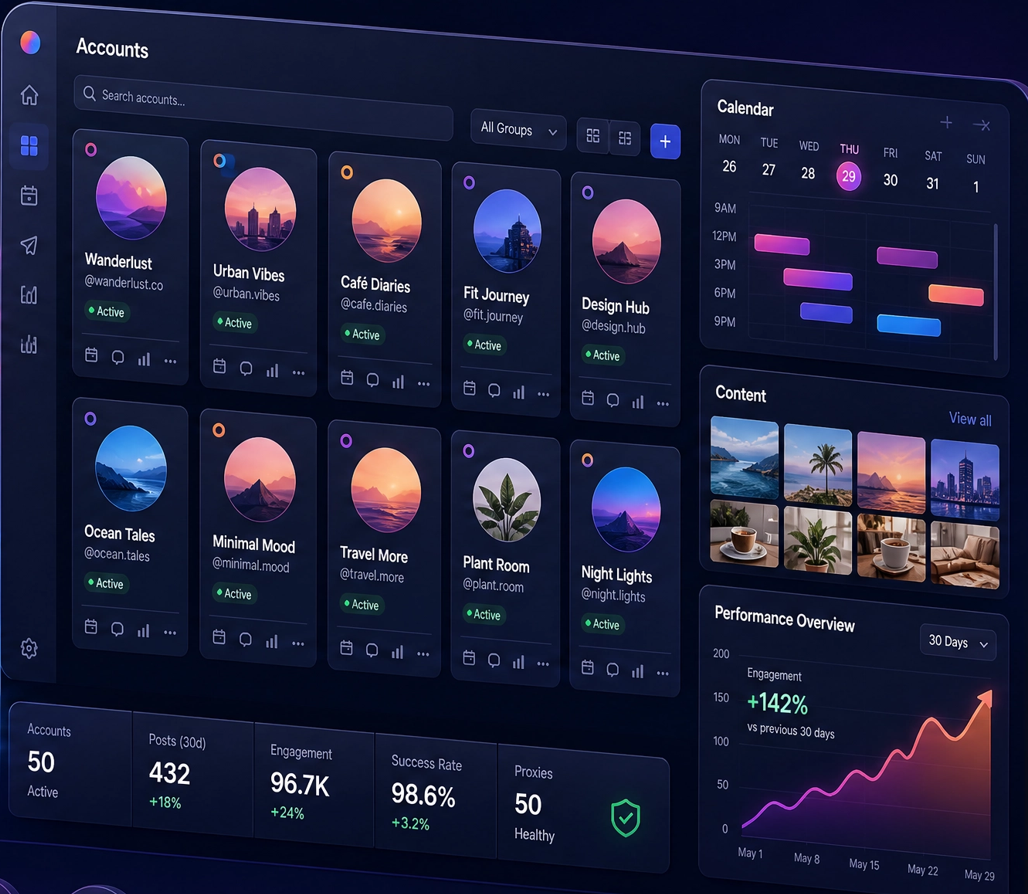
For marketers managing multiple social media accounts, JarveePro provides an automation layer for large-scale social media publishing.
Instead of treating every account as an isolated publishing task, marketers can manage accounts and campaigns centrally and use reusable content as part of their publishing strategy.
This is particularly relevant for video-heavy workflows where the same content needs to reach multiple managed accounts.
The important idea is not simply “post the same video everywhere.”
It is: Build a system where valuable video content can be distributed across the audiences and accounts that matter to your marketing strategy.
That distinction is what turns automation from a shortcut into a scalable marketing infrastructure.
The Future of Social Media Video Marketing Is Distribution
Creating video will remain important.
But as the amount of content produced by businesses and creators continues to increase, distribution becomes an increasingly valuable competitive advantage.
The marketers who can efficiently create, organize, repurpose, and distribute content will have more opportunities to turn each piece of creative work into measurable results.
You don't necessarily need to create 100 videos to reach 100 audiences.
Sometimes, the bigger opportunity is figuring out how to get the right existing videos in front of more relevant audiences.
That is the promise of scalable video publishing.
Conclusion
The biggest challenge in social media video marketing isn't always content creation.
It is making sure the content you have actually gets distributed.
One video can be valuable to one account.
But that same video may also be valuable to dozens, hundreds, or more accounts when the audiences and marketing objectives make sense.
As the number of social media accounts grows, manual publishing becomes increasingly difficult to maintain.
A scalable approach treats video as a reusable marketing asset and uses automation to handle repetitive distribution work.
The result is a simple but powerful shift in mindset:
Don't just create more videos. Get more value from every video you create.
That is where multi-account video publishing becomes more than a productivity trick.
It becomes a scalable video marketing strategy.